Cold Storage Solar in Rajasthan: Load, Backup and Subsidy Checklist
Cold storage solar needs a load-first plan, not a generic rooftop estimate. This Rajasthan checklist explains how to review refrigeration demand, roof or ground area, backup, net metering, subsidy claims and documents before asking for a commercial solar proposal.
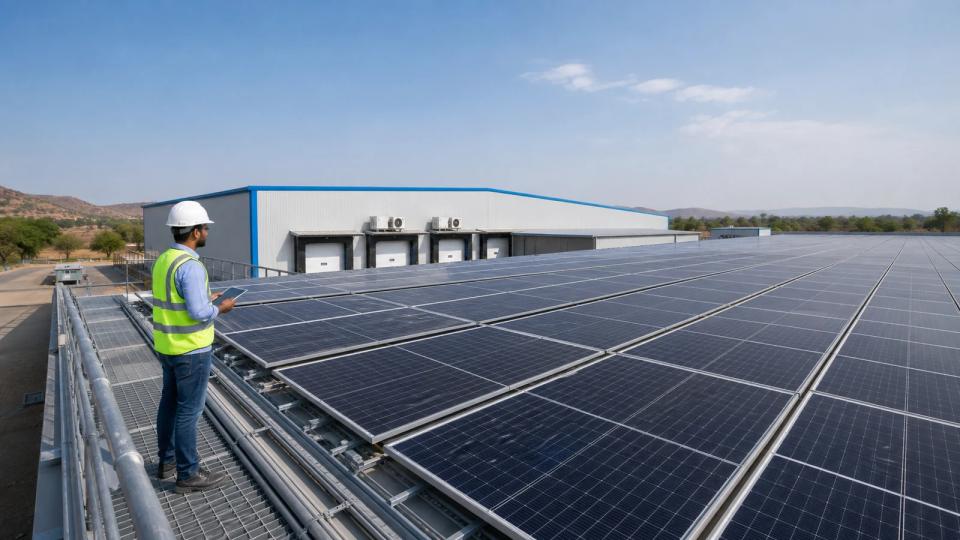
Direct answer: Cold storage solar in Rajasthan should start with refrigeration load profiling, not a generic kW estimate. Check daytime compressor demand, sanctioned load, roof or ground area, net-metering feasibility, backup needs and subsidy eligibility before finalising system capacity or payback.
Last reviewed: 5 July 2026. This guide is for Rajasthan cold-storage owners, food processors, warehouses and agro-businesses comparing commercial solar options. All savings, subsidy and backup conclusions require site survey, current tariff review, scheme eligibility checks and engineering design.
Key takeaways
- Cold storage solar is a load-first project because refrigeration demand, compressor cycling and operating hours decide the useful solar capacity.
- Rooftop solar can reduce daytime grid consumption, but it usually does not replace grid or generator backup for refrigeration.
- Subsidy checks must distinguish rooftop solar, solar cold-storage equipment and cold-chain infrastructure schemes.
- Rajasthan sites need extra attention to heat, dust, roof strength, drainage, panel cleaning, inverter ventilation and DISCOM metering.
- A serious quotation should use bills, sanctioned load, connected-load details, roof drawings and operating-hour data.
What does “cold storage solar” actually mean?
The phrase is used in two different ways. A food-processing entrepreneur may mean a dedicated solar cold room or cold-storage technology with thermal-energy-storage backup. A running warehouse or cold storage may mean a grid-connected rooftop or ground-mounted solar plant that offsets its electricity bill. Mixing these meanings creates wrong subsidy expectations and poor system sizing.
| Use case | What it usually covers | Important caution |
|---|---|---|
| Dedicated solar cold storage | Cold-room equipment designed with solar input and sometimes thermal energy storage. | Use technical specifications and scheme conditions carefully. MNRE has issued solar cold-storage design and testing guidance. |
| Rooftop or ground solar for an existing cold storage | Commercial solar plant connected to the facility to reduce daytime grid consumption. | It must be sized from actual load data, roof area, transformer/metering limits and DISCOM process. |
| Hybrid or battery-supported solar | Solar with battery or selected backup for control loads, lighting or limited critical loads. | Full refrigeration backup can be expensive and must be engineered separately. |
When is rooftop solar suitable for a cold storage?
A cold storage is a good solar candidate when it has significant daytime electricity consumption and enough usable area. Rajasthan facilities often have large roofs, but usable solar area depends on sheet condition, load-bearing capacity, shading, maintenance walkways, drainage, fire access and future expansion plans. Start with the Roof Area Calculator, then confirm the structure during a site survey.
The best fit is usually a facility where refrigeration, pre-cooling, grading, packaging, office loads, pumps and lighting create a stable daytime demand. If the major compressor load shifts to night or the site already has a complicated backup arrangement, the solar design must be more conservative.
Load data to collect before asking for a quote
A generic “per kW” estimate is weak for cold storage because refrigeration is not like a simple lighting load. Ask your team to collect these inputs before requesting a commercial proposal from NVH Solar’s Cold Storage Solar service.
| Input | Why it matters | What to share |
|---|---|---|
| Electricity bills | Shows monthly units, demand charges, sanctioned load and seasonal variation. | At least 12 months of bills and any TOD or demand-charge details. |
| Compressor and refrigeration load | Decides whether solar generation matches daytime demand. | Compressor rating, number of units, operating schedule and temperature set-points. |
| Auxiliary load | Pumps, fans, lighting, packaging and office load can improve solar self-consumption. | Connected-load list and daytime operating hours. |
| Roof or ground area | Limits maximum practical capacity. | Roof drawings, photos, access points, shaded zones and future expansion plans. |
| Existing backup | Solar design must coordinate with generator, UPS, battery or controls. | DG rating, changeover method, critical loads and runtime expectations. |
| Metering and transformer details | DISCOM feasibility depends on connection and protection assumptions. | Meter type, transformer details, sanctioned load and service connection documents. |
Backup: solar panels alone are not a refrigeration guarantee
For most commercial cold storages, the first design step is on-grid solar for daytime bill reduction. Solar panels produce during daylight; compressors and temperature-control equipment may also need reliable power after sunset, during grid outage or during cloudy periods. That is why “solar plus backup” must be designed separately from a normal rooftop plant.
Battery backup may be useful for controls, lighting, monitoring, small office loads or selected critical circuits. Full refrigeration backup needs deeper engineering because compressor starting current, runtime, temperature tolerance and product risk all matter. MNRE’s solar cold-storage guidance also shows why thermal-energy-storage backup is a specialised design area, not a casual add-on.
Subsidy and scheme checks: what to verify
Cold storage subsidy questions are common, but the answer is not automatic. MoFPI’s cold-chain scheme and its revised operational guidelines dated 22.05.2025 are about eligible cold-chain and value-addition infrastructure. NHB also has a capital-investment subsidy page for construction, expansion or modernisation of cold storages for horticulture products. These schemes depend on project type, capacity, location, ownership, documents and current guidelines.
That means a Rajasthan cold-storage owner should not assume that every rooftop solar plant receives a cold-chain subsidy. Treat the solar proposal, cold-chain project application, financing, tax treatment and DISCOM approval as connected but separate checks. Use a financial adviser for tax or depreciation treatment and the relevant scheme authority for subsidy eligibility.
Rajasthan-specific design checks
Rajasthan gives strong solar potential, but the same climate also creates design and maintenance risks. High summer temperature affects equipment ventilation, dusty roofs need safe cleaning access, monsoon drainage must remain open, and metal-sheet roofs need careful structural checks. Cable routes, isolators, earthing and protection devices should be planned for a commercial site, not improvised after installation.
Grid-connected systems also need DISCOM and RERC-aware planning. Before final capacity is selected, verify sanctioned load, export treatment, metering feasibility and protection requirements. NVH Solar can connect this check with Net Metering Assistance where a grid-connected design is feasible.
Indicative system-planning sequence
- Collect 12 months of bills, load list and operating-hour data.
- Use the Solar Generation Calculator only for a first estimate; do not treat it as a final design.
- Review roof or ground area, shading, structure and maintenance access.
- Separate daytime bill reduction from backup requirements.
- Check DISCOM metering, sanctioned load, export assumptions and RERC-linked rules.
- Review MoFPI, NHB or other scheme eligibility only for the correct project category.
- Compare CAPEX, financing, maintenance and tax advice using the Solar ROI Calculator as a starting point.
- Request a site-specific proposal and avoid guaranteed payback claims.
Where NVH Solar fits
NVH Solar is a Rajasthan solar installation and service company. For cold storages, the practical work is to inspect the load profile, roof or ground area, metering constraints, safety access, maintenance needs and commercial payback before recommending an on-grid, hybrid or phased solar scope. For broader commercial facilities, see Commercial and Industrial Solar.
CTA: If you run a cold storage, packhouse, agro-warehouse or food-processing facility in Rajasthan, request a cold storage solar survey with your electricity bills, load list and roof photos. NVH Solar can then prepare a site-specific quotation instead of a generic estimate.
Source references
- MNRE solar cold storage design and testing guidance.
- MoFPI Cold Chain scheme page and 22.05.2025 revised operational guidelines notice.
- NHB capital-investment subsidy page for horticulture cold storages.
- RERC regulations page.
FAQs
Is rooftop solar suitable for every cold storage?
No. Rooftop solar is suitable only when the site has enough shadow-free roof or ground area, a compatible sanctioned load, safe structure, clear maintenance access and a useful daytime refrigeration or auxiliary load. A cold storage with limited roof area or mostly night-time demand may need a different design.
Does solar remove the need for grid or generator backup?
Usually no. Standard grid-connected solar reduces daytime grid consumption but does not replace backup for compressors, controls, lighting or safety loads. Battery or thermal-energy-storage backup must be designed separately after load profiling and reliability review.
Can cold storage solar get subsidy in Rajasthan?
Possibly, but the applicable support depends on the project type, ownership, capacity, location and scheme conditions. MoFPI and NHB cold-chain or horticulture schemes are project-specific; they should not be treated as an automatic rooftop solar subsidy.
What documents are needed before asking for a solar quote?
Share at least 12 months of electricity bills, sanctioned load, connected-load list, compressor details, operating hours, roof or ground drawings, existing backup details, transformer or meter information and any cold-chain subsidy application documents.
Should a cold storage use on-grid, hybrid or off-grid solar?
Most commercial cold storages start with on-grid solar for daytime bill reduction. Hybrid or battery-supported designs can help selected control, lighting or critical loads, but full refrigeration backup needs careful economics and engineering.
How should payback be calculated for cold storage solar?
Use actual half-hourly or monthly consumption, daytime load share, tariff, demand charges, export treatment, maintenance cost, financing and tax advice. Do not rely on a generic per-kW saving claim without site-specific data.