Commercial Solar Subsidy in Rajasthan: Depreciation and ROI Checklist
Rajasthan businesses often ask whether commercial rooftop solar gets subsidy. This guide separates residential PM Surya Ghar subsidy from business ROI, depreciation, tariff, net-metering and CAPEX checks before a factory, hotel, office or institution approves solar.
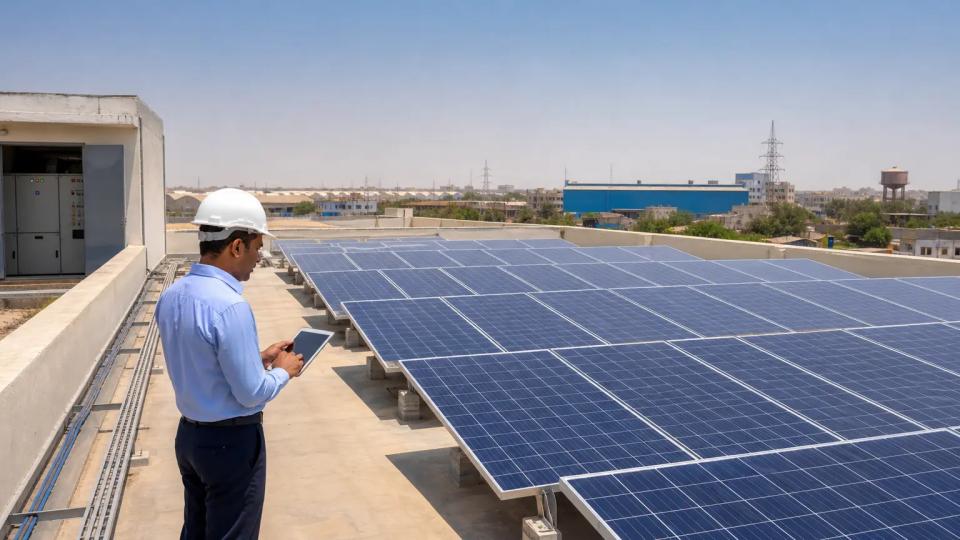
Direct answer: Commercial solar subsidy in Rajasthan is not the same as PM Surya Ghar household subsidy. A business should first separate residential CFA, commercial depreciation, DISCOM export treatment, project ownership and tariff savings before approving solar. For most factories, hotels, schools and offices, the real decision is ROI with verified tax and grid assumptions.
Last reviewed: 19 June 2026. This article is educational and not tax, legal or subsidy-approval advice. Ask your CA and the relevant DISCOM to confirm project-specific eligibility before signing a commercial solar contract.
Key takeaways
- PM Surya Ghar is documented by MNRE/PIB as a residential-sector rooftop solar programme, so business owners should not assume household CFA applies to commercial premises.
- The Income Tax Department's New Appendix I lists solar power generating systems under a 40 depreciation-rate entry for renewable energy devices; the actual tax benefit depends on the business case.
- Commercial ROI depends more on daytime self-consumption, electricity tariff, sanctioned load, export treatment, roof safety and financing cost than on subsidy alone.
- Rajasthan businesses should verify RERC rules, DISCOM process and project structure before assuming net metering, net billing or green open access.
- A site survey and load analysis should come before vendor quote comparison, especially for factories, hotels, hospitals, schools, warehouses and offices.
Why this query is confusing for Rajasthan businesses
Search demand around "commercial solar subsidy in Rajasthan" is commercially useful because buyers are usually close to a purchase decision. The confusion comes from mixing three different ideas: household subsidy, business tax treatment and electricity-bill savings. A residential subsidy headline may not apply to a factory meter, while depreciation may help only a tax-paying business that owns and capitalizes the asset correctly.
NVH Solar installs and plans commercial and industrial solar in Rajasthan, but the financial model must be checked against the customer's meter category, tariff, roof, ownership model and accountant's advice. A hotel in Jaipur, a school in Kota and a factory near Bhilwara can all need different project structures.
Commercial solar subsidy, depreciation and ROI: what to check
| Item | What it means | What to verify before approval |
|---|---|---|
| PM Surya Ghar CFA | Central financial assistance for residential households under PM Surya Ghar. | Do not apply household subsidy to a commercial meter unless an official scheme explicitly allows it. |
| Solar depreciation | Income-tax depreciation route for eligible business-owned solar assets. | Confirm ownership, capitalization date, put-to-use date, asset block and applicable tax treatment with a CA. |
| Bill savings | Reduction in grid consumption when solar power is used during business hours. | Use actual load curve, tariff category, demand charges and self-consumption percentage. |
| Export treatment | How surplus power is credited, settled or restricted. | Check the latest RERC and DISCOM route for net metering, net billing or green open access. |
| CAPEX vs OPEX | Whether the business owns the system or buys solar power under a contract. | Compare upfront cost, depreciation eligibility, contract tariff, roof tenure and exit clauses. |
Is PM Surya Ghar subsidy available for commercial solar?
PM Surya Ghar should be treated as a residential-household scheme unless an official notification says otherwise for your case. PIB/MNRE describes the programme as targeting rooftop solar installations in one crore households in the residential sector by FY 2026-27. PIB also lists household subsidy slabs up to ₹78,000 for systems above 3 kW.
That does not mean commercial solar has no financial benefit. It means the benefit usually has to be checked under a different heading: tariff savings, depreciation, financing, captive use, open access, or any sector-specific incentive that is live on the date of approval. For residential customers, see NVH Solar's separate page on PM Surya Ghar subsidy in Rajasthan.
How solar depreciation can affect business ROI
The Income Tax Department's New Appendix I lists renewable energy devices including solar power generating systems under a 40 depreciation-rate entry. A simple arithmetic example: if an eligible business-owned solar asset block is ₹10,00,000 and the applicable depreciation rate is 40%, the depreciation amount is ₹4,00,000. The actual tax saving is not ₹4,00,000; it depends on the business's taxable income and applicable tax rate.
This is why commercial solar ROI should not be sold as a guaranteed payback. The accountant must confirm asset ownership, invoice classification, capitalization, date put to use and whether the business can actually use the depreciation in that year.
Rajasthan-specific checks before a commercial solar quote
Rajasthan has strong solar potential, but commercial rooftops also face heat, dust, wind-load, parapet, fire-access and cable-routing constraints. In older factory buildings, structural checks can be more important than squeezing maximum kW onto the roof. In hotels and hospitals, daytime load may be high, but critical loads and backup arrangements need careful separation.
- Collect 12 months of electricity bills and sanctioned-load details.
- Separate daytime base load from evening or night consumption.
- Check roof ownership, lease tenure, waterproofing, asbestos risk and structural load capacity.
- Confirm whether the consumer falls under JVVNL, AVVNL or JDVVNL and whether the project is LT, HT, net-metered, net-billed, captive or open access.
- Review inverter placement, fire clearances, earthing, lightning protection and maintenance access.
- Use the solar calculator only as an early estimate; use a site survey for investment decisions.
How to calculate commercial solar ROI safely
A safe ROI model should show assumptions rather than only a payback number. At minimum, include system size, gross project cost, annual generation estimate, self-consumption percentage, tariff, demand-charge effect, export treatment, O&M cost, inverter replacement allowance, insurance, finance cost, degradation and tax depreciation. If any input is unknown, mark the result as indicative.
For a grid-connected business project, also read NVH Solar's on-grid solar systems page and the related JVVNL net metering checklist. For larger commercial loads, RERC's Green Energy Open Access and distributed renewable regulations should be checked with the current DISCOM process.
When should a Rajasthan business proceed?
Proceed when the site survey, structural review, load analysis, DISCOM route, financial assumptions and tax review all point in the same direction. Pause when the quote depends on unverified subsidy, unrealistic export credit, missing roof permissions or an unsupported payback promise.
CTA: If you are planning solar for a factory, hotel, hospital, school, warehouse or office in Rajasthan, book a free solar site survey with NVH Solar. The team can review your bills, roof and commercial use case before preparing a proposal.
Sources
- PIB/MNRE, PM Surya Ghar Yojana scale update, 24 March 2026
- PIB/MNRE, PM Surya Ghar subsidy details, 13 March 2025
- Income Tax Department, New Appendix I depreciation rates
- Rajasthan Electricity Regulatory Commission regulations page
FAQs
Is there commercial solar subsidy in Rajasthan?
PM Surya Ghar subsidy is a residential-household scheme, so a normal business, factory, hotel, school or office should not assume the same CFA applies. Commercial projects should verify any active state, MSME, sector-specific or institutional incentive separately before using subsidy in ROI calculations.
Can a Rajasthan business claim depreciation on a solar plant?
The Income Tax Department's New Appendix I lists renewable energy devices including solar power generating systems under a 40 depreciation-rate entry. Eligibility and timing depend on ownership, asset use, capitalization, tax regime and books of account, so the final claim should be checked with a chartered accountant.
How should a factory calculate commercial solar ROI?
Use actual sanctioned load, daytime consumption, tariff, expected self-consumption, export treatment, gross project cost, O&M, inverter replacement, financing cost and applicable depreciation. Do not calculate ROI only from panel capacity; a load profile and rooftop survey are necessary.
Does net metering work for commercial solar in Rajasthan?
Commercial consumers may have routes under distributed renewable energy or green open access rules, depending on connection category, capacity, DISCOM and project structure. Check the latest RERC rules and the relevant DISCOM before assuming net metering, net billing or open access treatment.
Is CAPEX or OPEX better for business solar?
CAPEX gives the business ownership control and potential depreciation treatment, but needs upfront investment. OPEX or RESCO can reduce upfront payment but shifts ownership, tariff and contract risk. The safer choice depends on credit profile, tax appetite, roof tenure and energy-use stability.
Should commercial solar be sized only to roof area?
No. Roof area is only one limit. The design should also match daytime load, sanctioned demand, export permissions, transformer capacity, structural safety, shadowing, fire access, maintenance access and future expansion plans.
Conclusion
Commercial solar in Rajasthan can be attractive even without assuming a business subsidy, but the decision must be built on verified tariff savings, tax treatment, roof feasibility and grid rules. Treat subsidy as a confirmed input only after official verification. Treat depreciation as a CA-reviewed tax input. Treat payback as indicative until NVH Solar has checked the actual site and load profile.
Speak with NVH Solar for a free commercial rooftop solar survey.