Factory and Warehouse Rooftop Solar in Rajasthan: Load, Roof and Payback Checklist
Factories and warehouses in Rajasthan can use rooftop solar well only when the system is matched to daytime load, roof strength, sanctioned demand, meter arrangement, safety clearances and maintenance access. This checklist helps owners ask the right questions before approving a commercial solar proposal.
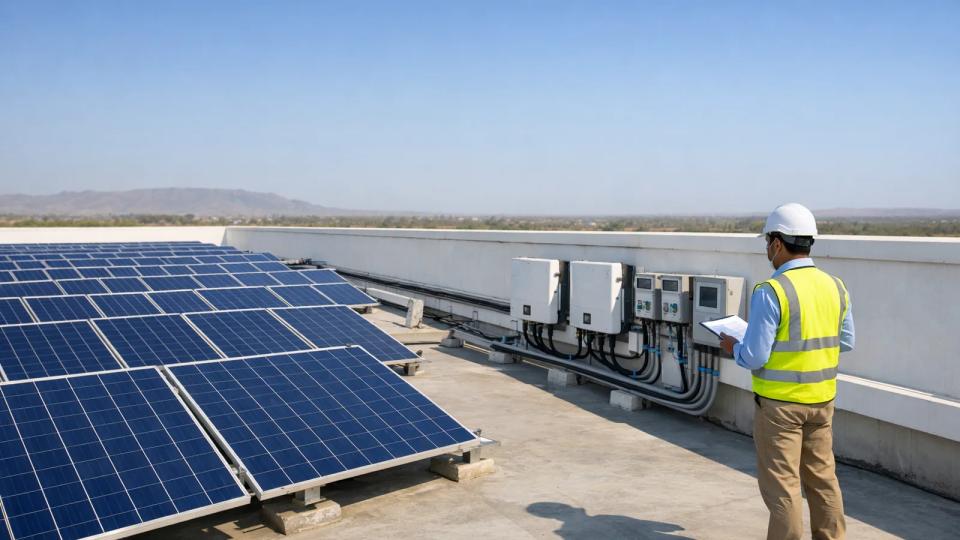
Direct answer: A Rajasthan factory or warehouse should approve rooftop solar only after checking daytime load, sanctioned demand, roof strength, shadow, fire access, inverter location, earthing, DISCOM metering route and payback assumptions. A credible proposal should show gross cost, expected self-consumption, maintenance scope and risks clearly instead of promising the same payback for every industrial roof.
Last reviewed: 26 June 2026. This article is an educational checklist for factories, warehouses and industrial buildings in Rajasthan. Final capacity, regulatory route, tariff treatment, tax effect and payback should be verified from the current bill, site survey, DISCOM/RERC position and professional tax advice.
Key takeaways
- Factories and warehouses need a load-led solar design, not only a roof-area estimate.
- Daytime consumption, sanctioned demand and operating days decide how much solar can be self-consumed.
- Roof strength, wind exposure, sheet condition, fire access and drainage can change the final installation cost.
- The Rajasthan DISCOM and RERC route should be checked before assuming net metering, net billing or another arrangement.
- Payback must be calculated from visible assumptions: gross price, generation estimate, self-consumption, O&M, degradation and finance or tax treatment.
Why factory and warehouse solar needs a separate checklist
A factory or warehouse roof is not the same as a home terrace. The electrical load may include motors, compressors, HVAC, cold storage, lighting, welding machines, packaging lines or weekend shutdowns. The roof may be RCC, metal sheet, north-light, truss-based or partly shaded by ventilation equipment. These details decide whether the right system is 30 kW, 100 kW, 500 kW or a phased project.
NVH Solar is a Rajasthan rooftop-solar installation and service company. For a commercial site, the first useful conversation should connect the electricity bill, production schedule and roof survey. The general commercial and industrial solar in Rajasthan page is the service starting point, but the checklist below helps a decision-maker test whether a quotation is technically complete.
Start with the load profile, not the panel count
A commercial solar proposal should begin with at least 12 months of electricity bills where available. The engineer should look at monthly units, maximum demand, sanctioned load, tariff category, power-factor charges if visible, operating shifts and seasonal load. A warehouse that uses mostly daytime lighting may absorb solar differently from a factory with heavy evening production.
Use the site’s own bill rate for any savings estimate. Do not use a generic tariff copied from another consumer category. The solar calculator can support a first estimate, but the commercial proposal should still show assumptions separately for bill units, system size, generation, self-consumption, export treatment and maintenance cost.
Commercial rooftop solar due-diligence table
| Check | What NVH Solar should verify | Decision impact |
|---|---|---|
| Electricity bill | Consumer category, sanctioned demand, connected load, units, demand charges and meter details. | Prevents wrong capacity and unrealistic savings. |
| Operating pattern | Day shifts, night shifts, weekly shutdowns, seasonal production and future load expansion. | Decides self-consumption and export risk. |
| Roof structure | RCC or sheet roof, purlins, waterproofing, age, load capacity and safe anchoring options. | Controls structure design and installation cost. |
| Shadow and layout | Water tanks, ducts, vents, neighbouring buildings, parapets and maintenance walkways. | Protects generation and makes cleaning safer. |
| Electrical room | Inverter location, AC/DC cable route, earthing, lightning protection, ACDB/DCDB and shutdown access. | Reduces downtime and inspection issues. |
| Regulatory route | DISCOM, RERC position, meter arrangement, approvals and documentation sequence. | Affects billing, commissioning and project timeline. |
| Commercial model | CAPEX, OPEX, loan, depreciation advice, O&M responsibility and insurance. | Changes cash flow, risk and ownership. |
Roof and safety checks that affect the quotation
For an industrial roof, panel layout must leave safe walking access, drainage paths, shutdown access and clearance around roof equipment. A metal-sheet roof may need clamp selection, purlin checks and leak protection. An RCC roof may need ballast, penetrations or elevated structures. Wind exposure in open Rajasthan industrial areas should not be treated casually.
The MNRE rooftop solar quality-control manual page was checked for this article, and the CEA safety-regulations listing was reviewed for current electrical-safety context. Practical checks should include structure design, cable containment, earthing, lightning protection, inverter ventilation, AC/DC protection devices and safe labels. These are not cosmetic items; they affect uptime, fire safety and maintenance access.
How to read the payback estimate
A serious factory solar payback sheet should display the inputs before showing the result. At minimum, ask for system capacity, estimated annual generation, performance ratio assumption, annual degradation, self-consumption percentage, export treatment, gross project cost, GST treatment, O&M cost, inverter replacement assumption where relevant, financing cost and tax/depreciation treatment confirmed by the business accountant.
| Payback input | What to ask for | Why it matters |
|---|---|---|
| Self-consumption | Expected percentage of solar units used inside the factory or warehouse. | Higher self-consumption usually improves savings reliability. |
| Bill rate | The effective rate from the actual commercial bill, not a generic tariff. | Wrong tariff assumptions distort payback. |
| O&M and downtime | Cleaning frequency, monitoring, inverter support and response time. | Commercial uptime affects the real return. |
| Finance and tax | Loan cost, accountant-confirmed tax treatment and ownership model. | CAPEX, OPEX and tax treatment change cash flow. |
Do not compare proposals only by the lowest per-kW price. A low quote can omit structure strengthening, proper walkways, surge protection, earthing, monitoring, cable trays, shutdown access or O&M. The solar panel price in Rajasthan guide can help compare cost language, but commercial buyers should compare the complete bill of materials and service scope.
Which system type usually fits a factory or warehouse?
Most factories and warehouses first evaluate an on-grid solar system because daytime load can consume a large share of generation. Hybrid or battery-backed designs may be useful for selected critical loads, but batteries should not be added without a load-priority list, backup-hour requirement and lifecycle-cost calculation.
Inverter design matters because commercial uptime depends on protection, ventilation, monitoring and fast service response. Ask who will maintain the inverter, what alarms are monitored, where isolators are installed and how shutdown will happen during maintenance. NVH Solar’s solar inverter service page is relevant when comparing equipment and support.
Questions to ask before approving a commercial solar proposal
- Which 12-month bill data was used for the calculation?
- What percentage of generation is expected to be consumed inside the factory or warehouse?
- What roof-load and wind-load assumptions are used?
- Which DISCOM/RERC metering route is assumed, and what approval steps are pending?
- What is included in structure, earthing, lightning protection, ACDB/DCDB, monitoring and O&M?
- What assumptions change if production shifts, expansion or tenant occupancy changes?
- Who signs off on tax, depreciation, insurance and accounting treatment?
CTA: If you manage a factory, warehouse, cold-storage unit or industrial shed in Rajasthan, request a commercial solar proposal from NVH Solar after sharing the latest bill and site photos. A site survey should confirm the final capacity and quote scope.
FAQs
Is rooftop solar useful for a factory in Rajasthan?
Yes, factory rooftop solar can work well when daytime electricity consumption is high and the roof can safely take the solar structure. The proposal should be based on actual bill data, sanctioned demand, roof survey, shadow analysis, safety requirements and expected self-consumption, not only on a per-kW price.
How is warehouse rooftop solar different from home solar?
Warehouse solar usually has a larger roof, higher sanctioned load, three-phase equipment, more fire-access requirements and different billing economics. The design must check roof sheets, purlins, wind load, cable routes, inverter placement, earthing and maintenance walkways before capacity is finalised.
What payback period should a factory owner assume?
A payback estimate should be calculated from the owner’s actual bill, gross project cost, expected generation, self-consumption, maintenance cost, degradation and any tax treatment confirmed by the accountant. NVH Solar should show the assumptions clearly instead of promising one fixed payback for every site.
Can a factory use net metering in Rajasthan?
The applicable route depends on the sanctioned load, system capacity, consumer category and current RERC/DISCOM rules. Smaller rooftop systems may follow distributed renewable or net-billing style processes, but the exact arrangement must be verified with the current DISCOM and RERC position before investment.
What should be checked during a factory rooftop solar survey?
The survey should check roof strength, sheet condition, shadow, orientation, drainage, fire access, structure anchoring, cable route, inverter room, earthing pits, lightning protection, meter room, shutdown access, dust exposure and space for safe maintenance. These checks affect cost and long-term uptime.
Should a business compare CAPEX and OPEX solar models?
Yes. CAPEX gives ownership and direct asset control, while OPEX or third-party models may reduce upfront capital but require contract, tariff, tenure and exit-condition review. The safer decision depends on cash flow, tax position, roof control, power use and management preference.
Sources reviewed
- MNRE rooftop solar quality-control manual page, checked 26 June 2026.
- RERC regulations page, checked 26 June 2026.
- CEA safety regulations listing, checked 26 June 2026.
- RERC orders page, checked 26 June 2026.
Conclusion
Factory and warehouse rooftop solar in Rajasthan can be commercially strong, but only when the quotation is tied to actual load, roof condition, safety scope and the correct approval route. Treat the first proposal as a technical and financial model that needs verification, not as a simple panel-price purchase.
Book the next step: Request a commercial solar proposal from NVH Solar with your latest electricity bill, roof type and operating schedule. NVH Solar can then size the system and survey the roof before final commercial commitment.