Non-DCR Solar Panels Under PM Surya Ghar: Rajasthan Guide
MNRE’s June 2026 clarification gives some PM Surya Ghar residential net-metering consumers a limited Non-DCR route if they voluntarily give up central subsidy. This Rajasthan guide explains when that route may or may not make sense.
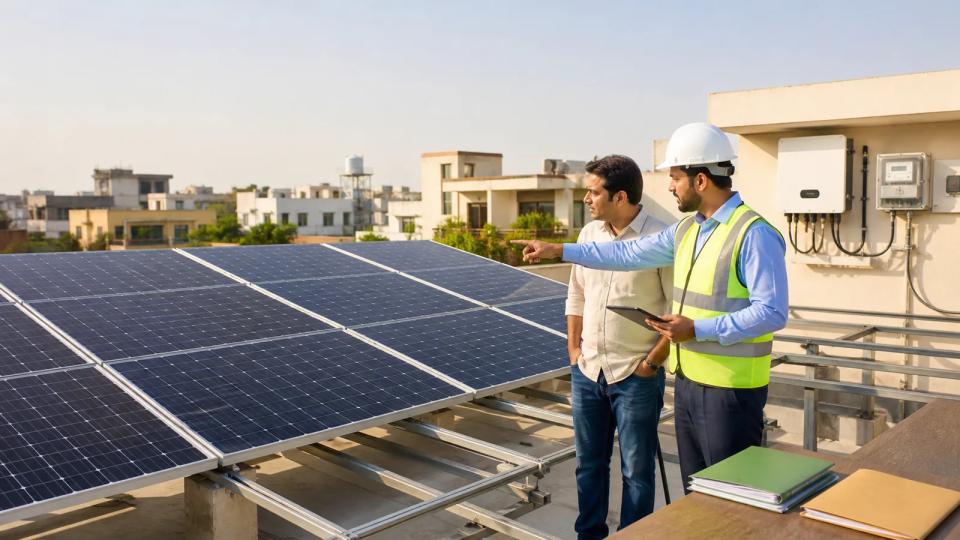
Direct answer: As of 2026-06-12, a Rajasthan residential net-metering consumer can consider Non-DCR solar modules under PM Surya Ghar only when using the Give It Up option and voluntarily forgoing Central Financial Assistance. Subsidy-seeking homeowners should continue with DCR/ALMM-compliant modules and complete the PM Surya Ghar and DISCOM verification flow.
Last reviewed: 2026-06-12. Author: NVH Solar Editorial Team.
Key takeaways
- MNRE’s 8 June 2026 clarification is narrow: it applies to residential rooftop solar consumers under PM Surya Ghar who choose Give It Up and use net metering.
- Giving up subsidy means the homeowner should compare the lost Central Financial Assistance against any reduction in module cost, availability or installation timeline.
- Consumers who want PM Surya Ghar subsidy should not assume Non-DCR panels are acceptable for their subsidy file.
- Rajasthan homeowners should check their JVVNL, AVVNL or JDVVNL consumer category, sanctioned load and bill history before choosing the application route.
- NVH Solar can review the electricity bill, roof, system size and documentation path before a homeowner commits to either route.
What changed in June 2026?
MNRE published an office memorandum dated 8 June 2026 clarifying a limited exemption from ALMM List-II requirements for solar PV cells. The clarification is linked to residential rooftop solar projects under PM Surya Ghar where the consumer chooses the Give It Up option and forgoes Central Financial Assistance.
The practical meaning is simple: the Give It Up route may allow a residential net-metering consumer to avoid the ALMM List-II cell requirement for the limited scheme period. It does not convert every Non-DCR rooftop project into a subsidy-eligible project, and it does not remove the need to apply through the PM Surya Ghar National Portal where the clarification says that route is mandatory.
For Rajasthan families, this is a purchase-decision issue, not just a policy headline. Before choosing panels, the homeowner should decide whether the household wants subsidy support or wants to voluntarily skip it in exchange for a different module procurement route.
What do DCR, Non-DCR and ALMM mean?
DCR means Domestic Content Requirement. In practical rooftop-solar language, DCR compliance connects the solar cells and modules to domestic-manufacturing requirements used in government-supported schemes. The DCR Verification Portal, operated by NISE under MNRE, is designed to trace and verify compliant cells and modules.
ALMM means Approved List of Models and Manufacturers. MNRE maintains lists for approved solar PV modules and cells. ALMM List-I refers to modules, while ALMM List-II refers to solar PV cells. For subsidy-linked residential rooftop solar, homeowners should treat current ALMM and DCR compliance as a documentation requirement, not as a small technical detail.
Non-DCR panels are panels that do not satisfy the domestic-content route required for particular government-supported claims. They can still be technically capable solar modules, but the question is whether they fit the selected scheme, subsidy and compliance path.
Should a Rajasthan homeowner choose Give It Up?
Give It Up may make sense only after comparing numbers. PM Surya Ghar subsidy support can be material for a residential system. PIB’s March 2025 scheme explainer lists subsidy support up to Rs 60,000 for 1-2 kW, Rs 60,000 to Rs 78,000 for 2-3 kW, and Rs 78,000 for systems above 3 kW under the stated consumption bands. A homeowner who gives up CFA should know what benefit is being waived.
- Homeowner wants PM Surya Ghar subsidy: use the DCR/ALMM-compliant subsidy route because the application depends on scheme compliance and DISCOM verification.
- Homeowner may waive subsidy for lower module cost or availability: use the Give It Up route only after a written comparison of the lost CFA against the real installed-price difference.
- Commercial building, factory, hotel or office: use a commercial solar proposal, not residential CFA logic, because PM Surya Ghar subsidy assumptions should not be applied to non-residential loads.
- Apartment society common load: verify the connection category and metering model first because common-area load, ownership and DISCOM category affect the approval path.
Rajasthan checklist before selecting DCR or Non-DCR panels
- Check the latest electricity bill. Confirm consumer name, address, sanctioned load, tariff category and monthly units. These details decide system sizing and approval risk.
- Identify the responsible DISCOM. Jaipur, Kota and Alwar consumers commonly deal with JVVNL; Udaipur, Ajmer and Bhilwara consumers commonly deal with AVVNL; Jodhpur and Bikaner consumers commonly deal with JDVVNL.
- Calculate the subsidy trade-off. Compare the quoted price with subsidy against the quoted price without subsidy. Do not decide from panel price per watt alone.
- Ask for written module compliance details. The quote should identify module make, wattage, warranty, ALMM/DCR status where relevant, inverter model, structure scope, cable size, earthing and monitoring.
- Review the roof before the application. Shading from water tanks, parapet height, adjacent buildings, dust exposure, roof strength and cable routing can change system size and generation.
- Keep the route consistent. Changing from subsidy to Give It Up, or the reverse, after procurement can delay documentation and create avoidable disputes.
How should the savings calculation be done?
Use site-specific assumptions instead of a generic promise. A practical Rajasthan calculation should include system size, installed cost, subsidy or no-subsidy route, estimated annual generation, electricity tariff, self-consumption, exported units, module warranty, inverter warranty, cleaning cost and AMC requirement.
NVH Solar’s solar calculator can provide a first estimate, but the final recommendation should come after a roof survey and bill review. Strong summer sunlight helps Rajasthan rooftop solar, but heat, dust, shading and maintenance discipline affect real output.
Where this fits in NVH Solar’s Rajasthan service flow
If the home is in Jaipur, start with the rooftop solar Jaipur guide and verify JVVNL details. For statewide homeowners, review NVH Solar’s PM Surya Ghar subsidy guide for Rajasthan and home rooftop solar service page before requesting a quote.
Most Give It Up decisions still involve an on-grid design, so the on-grid solar systems page is relevant. If the project includes backup or batteries, the decision should be separated from the subsidy question because hybrid and storage economics follow a different calculation.
Practical next steps
- Collect your latest electricity bill and 12-month unit history if available.
- Ask whether your quote is subsidy-linked, Give It Up, or a non-subsidy private installation.
- Request a written comparison of DCR/ALMM-compliant modules and any proposed Non-DCR alternative.
- Confirm that the installer will follow the correct PM Surya Ghar National Portal and DISCOM process for your selected route.
- Book a roof survey before paying a large advance.
Source references
- MNRE ALMM page, accessed 2026-06-12: official listing for the 8 June 2026 clarification and ALMM updates.
- MNRE office memorandum dated 8 June 2026, accessed 2026-06-12: limited ALMM List-II exemption for Give It Up residential net-metering consumers.
- MNRE Grid Connected Rooftop Solar Programme, accessed 2026-06-12: CFA route and DISCOM verification context.
- NISE DCR Verification Portal, accessed 2026-06-12: DCR traceability and verification role.
- PIB PM Surya Ghar explainer, posted 13 March 2025, accessed 2026-06-12: subsidy slabs and national scheme context.
Conclusion
The Non-DCR route is not a shortcut to subsidy. It is a limited option for eligible residential consumers who consciously choose Give It Up under PM Surya Ghar. For many Rajasthan homeowners, the subsidy route will still be financially stronger. For some homes, a no-subsidy route may be worth comparing if the installed-cost difference is clear and documented.
NVH Solar can review your electricity bill, roof layout, module options and DISCOM path before you decide. Book a free rooftop survey to compare subsidy and Give It Up options with a Rajasthan-specific system recommendation.
FAQs
Can I use Non-DCR solar panels and still get PM Surya Ghar subsidy?
Do not assume that. As of 12 June 2026, the Non-DCR route discussed in MNRE’s clarification is tied to the Give It Up option, where the residential consumer forgoes Central Financial Assistance. If you want subsidy, ask for DCR/ALMM-compliant module details in writing.
What is Give It Up under PM Surya Ghar?
Give It Up is the option where a residential rooftop solar consumer voluntarily forgoes Central Financial Assistance so scheme benefits can reach other consumers. MNRE’s June 2026 clarification says such residential net-metering consumers must still apply through the PM Surya Ghar National Portal.
Does the June 2026 MNRE clarification apply to commercial solar?
No, not as a general commercial-solar rule. The clarification is for residential rooftop solar projects under PM Surya Ghar using the Give It Up option. Factories, offices, hotels and schools should use a commercial solar proposal and not rely on residential subsidy assumptions.
Which DISCOM should Rajasthan homeowners check with?
The relevant DISCOM depends on location and connection. Jaipur, Kota and Alwar commonly fall under JVVNL; Udaipur, Ajmer and Bhilwara commonly fall under AVVNL; Jodhpur and Bikaner commonly fall under JDVVNL. Always verify from the latest electricity bill.
Is Non-DCR cheaper than DCR for rooftop solar?
It can be cheaper in some quotes, but the final decision should compare complete installed system cost, subsidy loss, warranty, inverter, structure, cables, earthing, monitoring and timeline. A lower panel price alone is not enough to choose the route.
Should I decide DCR or Non-DCR before the site survey?
Start the discussion before the site survey, but decide after the installer checks roof area, shading, sanctioned load, monthly consumption and documentation. The selected route should be clear before procurement and application submission.