On-Grid vs Hybrid Solar in Rajasthan: Battery Backup Guide
Confused between an on-grid rooftop solar system and a hybrid solar system with battery backup? This Rajasthan-focused guide explains when batteries are useful, when net metering is enough, and what to verify before accepting a quote.
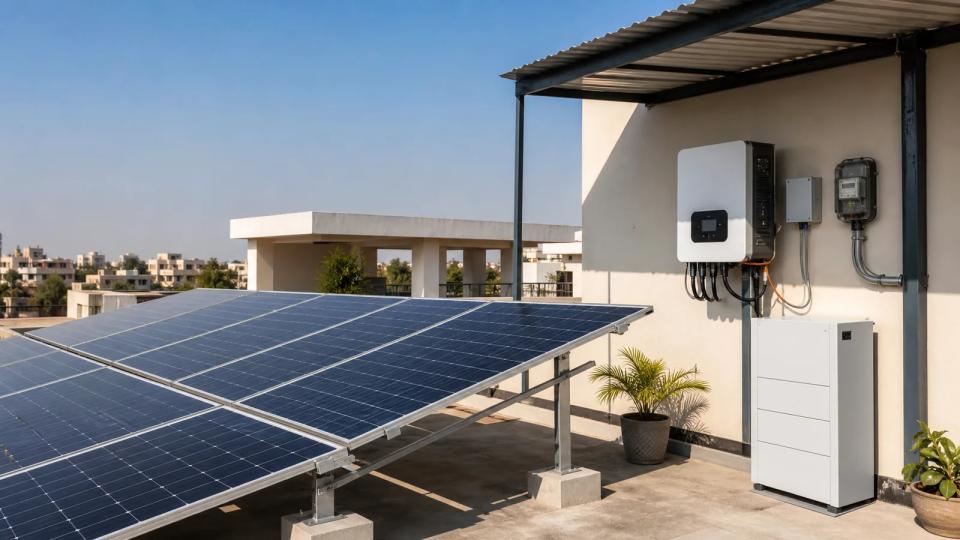
Direct answer: Choose on-grid solar when your Rajasthan home mainly wants lower electricity bills and the grid is reasonably reliable. Choose hybrid solar only when battery backup for essential loads is worth the added inverter, battery, safety and replacement cost. Do not assume batteries are automatically subsidy-linked; verify the DISCOM and National Portal route first.
Key takeaways
- On-grid rooftop solar sends surplus generation to the grid through the approved metering arrangement; it normally shuts down during a power cut for safety.
- Hybrid solar adds a battery-capable inverter and battery storage so selected loads can run during outages.
- Google Trends checked on 17 June 2026 showed stronger Rajasthan demand for “solar inverter” and “solar battery” than for narrow hybrid terms, so the buyer question is usually about inverter and battery need, not only system labels.
- For PM Surya Ghar, confirm subsidy treatment through the National Portal, vendor and DISCOM. CFA should not be assumed on battery cost unless the official workflow supports it.
- A good quote must separate solar module capacity, inverter type, usable battery kWh, protections, installation scope, net-metering support and AMC.
Why this question matters in Rajasthan now
NVH Solar’s live site already has service pages for on-grid solar systems, hybrid solar systems, solar inverter sales and service and solar batteries and storage. The missing content gap is a practical decision guide: when should a homeowner pay extra for battery backup, and when is a simpler grid-connected rooftop system better?
The search signal supports that gap. Rajasthan Google Trends retries for the past 30 days showed mean interest of 61.28 for “solar inverter” and 14.03 for “solar battery”, while “hybrid solar system” was much smaller at 1.5. India-level Trends showed the same pattern, with “solar inverter price” and “solar battery price” carrying stronger purchase intent. Google autocomplete also returned “on grid vs hybrid solar system”, “solar battery backup for home”, “hybrid solar inverter price” and Hindi/Hinglish terms such as “सोलर इन्वर्टर बैटरी” and “सोलर बैटरी बैकअप”.
On-grid, hybrid and off-grid solar: practical comparison
| System type | Best fit | Battery needed? | Main caution |
|---|---|---|---|
| On-grid rooftop solar | Homes, offices and shops with reliable grid supply and a bill-reduction goal | No, not normally | Usually does not provide backup during a power cut; depends on approved metering and grid availability. |
| Hybrid solar | Homes or businesses that need backup for selected loads such as lights, fans, Wi-Fi, computers or medical equipment | Yes, for backup use | Higher cost, more design checks and battery replacement planning. |
| Off-grid solar | Remote locations without practical grid access | Yes | Needs larger storage and conservative load planning; it is not usually the first choice for urban Rajasthan homes. |
When is on-grid solar enough?
On-grid solar is usually the safer first option when the property has a stable grid connection, daytime consumption, and a clear bill-reduction goal. It is also simpler for many residential PM Surya Ghar cases because the official residential rooftop flow is built around grid-connected rooftop solar and DISCOM verification.
Use NVH Solar’s solar calculator for a first sizing estimate, then confirm the actual recommendation through a roof survey. The survey should check shadow-free area, sanctioned load, cable route, meter-board access, earthing location and whether the selected DISCOM is JVVNL, AVVNL or JDVVNL.
When does hybrid solar make sense?
Hybrid solar makes sense when backup reliability is a defined requirement, not just a sales add-on. A Jaipur family that wants lights, fans, router and one work-from-home desk during outages may need a different system than a villa that expects air-conditioners, pumps or a full kitchen to run during cuts. The backup load list must be written before the battery size is selected.
For Rajasthan rooftops, also check inverter placement and battery ventilation. Strong summer heat, dust, monsoon moisture and rooftop access constraints can affect equipment life. A battery cabinet should be protected from direct water exposure, excessive heat and untrained access. Earthing, surge protection and safe cable routing are not optional line items.
Simple backup calculation buyers can understand
Backup time is not decided only by the solar panel size. It depends on usable battery energy, active load and inverter settings. A first estimate is:
Estimated backup hours = usable battery kWh ÷ backup load kW
| Example backup load | Usable battery energy | Indicative backup before losses | What it means |
|---|---|---|---|
| 0.5 kW essentials | 5 kWh | About 10 hours | Lights, fans, router and small electronics may be feasible if actual load is controlled. |
| 1.0 kW essentials | 5 kWh | About 5 hours | Useful for home-office backup, but appliance discipline matters. |
| 2.0 kW mixed load | 5 kWh | About 2.5 hours | Higher loads drain batteries quickly; check inverter rating and surge loads. |
These are indicative calculations, not guarantees. Real backup depends on battery usable depth, inverter efficiency, battery temperature, age, reserve settings and appliance surge currents.
Subsidy and DISCOM checks before choosing a battery
MNRE’s grid-connected rooftop programme page states that residential consumers use the National Portal or DISCOM portal mechanisms for CFA and that installation is verified by State DISCOMs. The PIB cabinet approval note for PM Surya Ghar lists CFA support capped at 3 kW for residential rooftop solar. A battery decision should therefore be separated from the solar-module subsidy decision unless the current official workflow clearly treats it otherwise.
RERC’s regulations page lists the RERC (Battery Energy Storage Systems) Regulations, 2026 dated 13 May 2026 and the RERC Grid Interactive Distributed Renewable Energy Generating Systems Third Amendment dated 3 December 2025. Mercom India reported on 27 February 2026 that JVVNL allowed hybrid inverters with rooftop solar under net, gross net and virtual net metering frameworks, while CFA calculations remain based on installed solar module capacity. Treat this as a current market signal and verify the exact DISCOM order before procurement.
Quote checklist for Rajasthan buyers
- Ask whether the proposal is on-grid, hybrid or off-grid, and whether the inverter can legally and safely operate in the selected mode.
- Separate solar module capacity in kW from inverter capacity and usable battery energy in kWh.
- List the exact backup loads: lights, fans, router, refrigerator, pump, computer, medical device or other equipment.
- Ask for earthing, lightning protection, surge protection, DC isolator, AC protection and cable specifications in writing.
- Confirm the DISCOM route: JVVNL, AVVNL or JDVVNL, and whether net metering, gross net metering or another arrangement applies.
- Check whether battery cost, hybrid inverter upgrade, monitoring and AMC are included or excluded from the quoted price.
- Verify subsidy-linked items through the PM Surya Ghar Rajasthan guide before making payment assumptions.
How NVH Solar can help
NVH Solar is a Rajasthan rooftop-solar installation and service company. For homes, offices and small businesses, the practical process should start with bill review, roof survey and a backup-load discussion. A good installer should be comfortable recommending on-grid solar when battery backup is unnecessary, not pushing every buyer toward a hybrid system.
If you are comparing quotes, book a free rooftop solar site survey through NVH Solar’s contact page or call +91 9509344453. For Jaipur properties, keep JVVNL and local roof-access constraints in the survey brief before finalising the proposal.
Source references
- MNRE Grid Connected Rooftop Solar Programme, accessed 17 June 2026: residential CFA and DISCOM verification context.
- PIB cabinet approval note on PM Surya Ghar, posted 29 February 2024, accessed 17 June 2026: CFA cap and National Portal context.
- RERC regulations page, accessed 17 June 2026: BESS Regulations 2026 and distributed renewable amendments.
- PIB / Ministry of Power note on BESS development, posted 30 March 2026, accessed 17 June 2026: national storage-policy context and Rajasthan BESS capacity above 1 MWh.
- Mercom India report on JVVNL hybrid inverters, posted 27 February 2026, accessed 17 June 2026: secondary market signal, not the primary legal source.
FAQs
Is on-grid or hybrid solar better for a Rajasthan home?
On-grid solar is usually better when the grid is reliable and the main goal is bill reduction. Hybrid solar is worth considering when backup for selected loads is important. The final choice depends on outage frequency, sanctioned load, battery budget, inverter approval, roof layout and DISCOM rules.
Does PM Surya Ghar require a battery?
No. PM Surya Ghar is a residential rooftop solar scheme, and a standard on-grid system can be installed without battery backup. Subsidy treatment should be verified through the National Portal, vendor and DISCOM because battery cost should not be assumed to receive the same CFA as solar module capacity.
Can a hybrid solar system work during a power cut?
A properly designed hybrid system can support selected backup loads during an outage when the battery has charge and the inverter is configured for backup output. It should not be treated as whole-house backup unless the load calculation, inverter capacity and battery usable capacity support that requirement.
How do I estimate solar battery backup time?
Use a simple first check: usable battery energy in kWh divided by backup load in kW. For example, a 5 kWh usable battery supporting a 1 kW essential load may provide about five hours before losses and reserve settings. The installer should calculate this using actual appliances.
Will a battery improve my solar savings?
A battery can improve reliability and self-use in some cases, but it adds cost and replacement planning. In many grid-connected Rajasthan homes, net-metered on-grid solar gives better financial value. Battery economics must be checked separately from bill savings and subsidy expectations.
What should I ask before accepting a hybrid solar quote?
Ask for solar module capacity, hybrid inverter model, battery usable kWh, battery chemistry, cycle/warranty terms, backup load list, earthing and surge protection scope, ventilation location, DISCOM approval route, net-metering treatment and a written note on what is and is not subsidy-linked.
Conclusion
For many Rajasthan homes, on-grid solar remains the most cost-effective first choice because the goal is lower bills through rooftop generation and approved metering. Hybrid solar is valuable when backup matters enough to justify battery cost, safety checks and future replacement planning. The right answer is not a product label; it is a bill, roof, load and DISCOM decision.
Book a free rooftop solar survey with NVH Solar to compare on-grid and hybrid options with a written backup-load and subsidy checklist.