Petrol Pump Solar in Rajasthan: Load, Canopy and Safety Checklist
Petrol pump solar needs more than a rooftop size estimate. This Rajasthan checklist explains how fuel-station owners should review canopy structure, daytime load, PESO safety guidance, billing, metering, backup and documents before requesting a solar proposal.
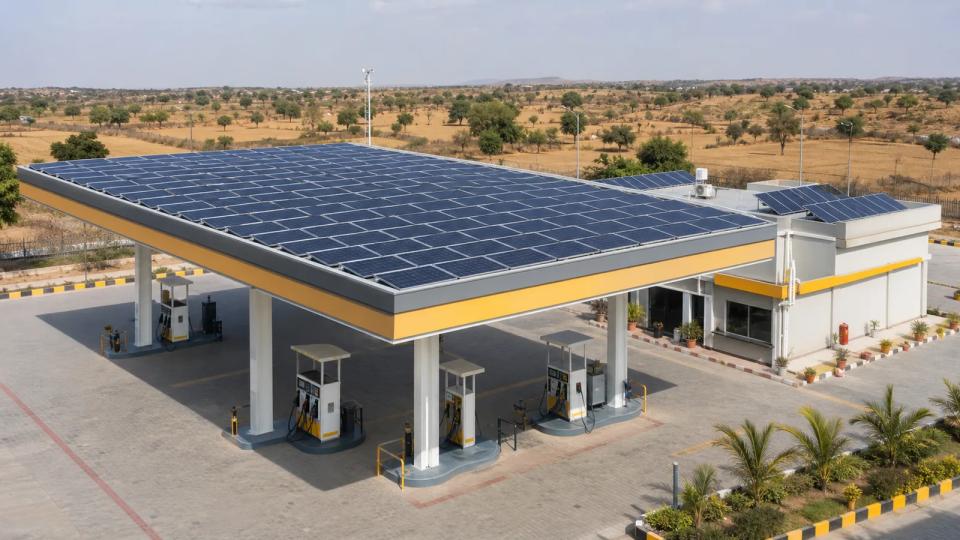
Direct answer: Petrol pump solar in Rajasthan can reduce daytime electricity use, but it must be designed around canopy safety, fuel-station electrical restrictions, PESO guidance, DISCOM metering and actual load data. Do not size it like a normal shop rooftop system without a site survey.
Last reviewed: 7 July 2026. This guide is for petrol pump owners, fuel-station operators and commercial property managers in Rajasthan. All capacity, savings and approval conclusions require current documents, applicable safety review and site-specific engineering.
Key takeaways
- Petrol pump solar is a safety-sensitive commercial project because fuel dispensing, canopy wiring and electrical equipment are close to regulated operating areas.
- The first step is not a kW quote; it is a load, canopy, electrical-room, earthing and approval checklist.
- PESO's 25 February 2025 guidance makes solar-panel installation at LNG/CNG/CBG retail outlets and service stations a real compliance topic, not just a marketing add-on.
- On-grid solar usually reduces daytime grid consumption. It does not automatically replace generator backup for dispensing, billing, lighting or safety systems.
- Commercial subsidy or tax treatment must be checked separately. Residential PM Surya Ghar subsidy should not be assumed for petrol pumps.
Why petrol pump solar is different from a normal rooftop system
A fuel station has a canopy, dispensers, underground or above-ground services, fire-safety equipment, customer movement, signage, billing systems and often long operating hours. A normal commercial rooftop solar design may ignore hazardous-area separation, restricted wiring routes, safe maintenance access and the owner's obligations under the oil marketing company or safety approvals.
That is why NVH Solar treats Petrol Pump Solar service enquiries as survey-led projects. The proposal should show what can be installed on the canopy, what should stay on the sales-room roof or another roof, how cable routes are protected and how shutdown or maintenance work will be handled without disturbing fuel-station safety.
Petrol pump solar feasibility checklist
| Checkpoint | What to verify | Why it matters |
|---|---|---|
| Canopy structure | Available area, load-bearing capacity, roof-sheet condition, drainage and wind exposure. | Solar modules, rails and cable trays must not overload or weaken the canopy. |
| Hazardous-area separation | Location of dispensers, vents, gas equipment, cable route and electrical isolation points. | Solar wiring must respect fuel-station safety restrictions and applicable PESO guidance. |
| Daytime load | Pumps, dispensers, canopy lights, office, compressor, CCTV, signage and any EV charger load. | Solar should match useful daytime consumption instead of chasing a generic system size. |
| Grid and metering | Sanctioned load, meter category, transformer connection, export treatment and DISCOM process. | Commercial net metering or billing assumptions must match Rajasthan rules and utility practice. |
| Maintenance access | Walkways, cleaning route, safe access points and shutdown procedure. | Canopy solar becomes risky if cleaning or inspection requires unsafe work above the forecourt. |
| Backup coordination | DG set, UPS, critical loads and power-quality requirements. | On-grid solar is not a generator replacement unless backup is separately engineered. |
How should the load be checked before sizing?
Start with at least 12 months of electricity bills and the sanctioned load. Then list every meaningful load: dispenser systems, fuel pumps, canopy lighting, office equipment, air compressor, water pump, CCTV, signage, POS or billing systems, tyre-inflator loads and any future EV charger. If the fuel station has half-hourly meter data, use it; otherwise, prepare a practical operating-hour profile.
A petrol pump with heavy daytime operation may use more solar directly than a site where lighting and auxiliary loads dominate after sunset. Use the Solar ROI Calculator only for indicative scenarios; the final payback should use tariff category, demand charges, export treatment, maintenance cost, finance cost and tax advice.
Where can the panels be installed?
The canopy is often attractive because it has a large, open plane. But the service-room roof, office roof, parking shade or separate commercial roof may be safer or easier for part of the system. A mixed design can reduce canopy clutter and simplify maintenance. The same thinking used in Solar Carport and Parking Systems applies: structure, wind load, drainage, wiring and maintenance access matter as much as module count.
In Rajasthan, strong heat, dust, summer winds and monsoon drainage make panel layout important. Leave safe access lanes, avoid blocking drainage, protect cable routes and place inverters in ventilated, serviceable locations away from unsuitable fuel-handling areas.
What approvals and safety checks are important?
Fuel-station owners should confirm the approval route before installation. PESO's 25 February 2025 guidance on installing solar panels at LNG/CNG/CBG retail outlets, service stations and ALDS locations shows why solar on fuel-station premises is a safety-governed topic. The exact route depends on site type, equipment, oil marketing company requirements and applicable licence conditions.
Electrical safety is also not optional. CEA safety regulations and MNRE rooftop PV quality-control guidance reinforce the need for correct earthing, protection, isolators, cable management, commissioning checks and maintenance documentation. For Rajasthan grid-connected systems, RERC and DISCOM assumptions around sanctioned load, metering and protection should also stay consistent. NVH Solar's Net Metering Assistance page is the relevant internal route for those checks.
Does petrol pump solar need batteries?
Not necessarily. Many petrol pumps should first evaluate on-grid solar for daytime bill reduction. Batteries may support selected control, lighting, billing or office loads, but running a full forecourt and dispensing operation during outages needs a separate critical-load and safety design. The existing DG set, UPS and interlocks must be reviewed before promising backup behaviour.
For most owners, the safer commercial question is: how much of the daytime bill can solar offset without complicating safety and operations? Backup should be treated as a second design decision, not a default add-on.
What documents should you prepare for a quotation?
- Last 12 months of electricity bills and sanctioned load details.
- Meter category, connection type, transformer details and demand-charge information where available.
- Canopy drawings, roof drawings or site photos showing dimensions and equipment locations.
- List of dispensers, pumps, compressor, signage, office loads, lighting and future EV charger plans.
- DG set and UPS details, including which loads are backed up.
- Existing approval, oil marketing company or safety documents that affect construction on the premises.
- Preferred installation window and restrictions on forecourt shutdown.
After these documents are ready, request a petrol pump solar survey so the proposal can separate confirmed site facts from assumptions.
What should not be claimed without proof?
Do not accept a proposal that guarantees a fixed bill reduction, fixed payback, guaranteed approval, automatic subsidy or generator replacement without site-specific proof. Petrol pump solar can be commercially useful, but the numbers must be labelled as indicative until billing data, tariff, load timing, export treatment and safety conditions are verified.
Sources and references
- Petroleum and Explosives Safety Organisation: Installation of solar panels at LNG/CNG/CBG retail outlets, service stations and ALDS guidelines — Fuel-station solar must be treated as a safety-sensitive installation where PESO guidance, hazardous-area separation and approval route are checked before work.
- Central Electricity Authority: Measures Relating to Safety and Electric Supply Regulations archive — Electrical work must preserve safe wiring, earthing, isolation, inspection and protection practices.
- Ministry of New and Renewable Energy: Quality Control Manual for Grid Connected Rooftop Solar PV System Final Draft — Rooftop solar quality checks include structure, electrical safety, commissioning, inspection, O&M and documentation.
- Rajasthan Electricity Regulatory Commission: Regulations page — Grid-connected commercial solar in Rajasthan must preserve sanctioned-load, metering, protection and DISCOM/RERC assumptions.
FAQs
Can solar panels be installed on a petrol pump canopy in Rajasthan?
Yes, solar panels can be considered on a petrol pump canopy when the structure, electrical routing, hazardous-area separation, earthing, access and approvals are suitable. Fuel-station owners should treat canopy solar as a regulated engineering job, not as a normal commercial rooftop installation.
Does PESO approval matter for petrol pump solar?
PESO guidance matters because retail outlets and service stations handle hazardous fuels. The owner, oil marketing company, solar installer and electrical contractor should confirm the applicable approval route and safety restrictions before any work starts.
What load data is needed before sizing petrol pump solar?
Use at least 12 months of electricity bills, sanctioned load, pump and dispenser load, lighting, compressor, office, CCTV, signage, EV charger if any, DG set details and operating hours. A daytime load profile helps avoid over-sizing.
Can petrol pump solar replace the generator?
Usually no. On-grid solar reduces daytime grid use but does not replace backup for dispensing, safety, lighting, billing systems or critical operations during outages. Backup must be assessed separately.
Is petrol pump solar subsidy available in Rajasthan?
Do not assume an automatic subsidy. Commercial fuel-station projects usually need project-specific checks for current schemes, tax treatment, net metering and utility rules. Residential PM Surya Ghar subsidy should not be applied to petrol pumps.
What should a petrol pump owner check before requesting a quote?
Check roof/canopy drawings, structural condition, shadow-free area, hazardous-zone restrictions, electrical room location, earthing route, maintenance access, sanctioned load, meter type, transformer connection and recent bills before asking for a proposal.
Conclusion
Petrol pump solar in Rajasthan is a strong commercial option when the canopy, load profile, electrical route and safety permissions support it. Treat the project as a fuel-station engineering job first and a solar ROI decision second. For a site-specific recommendation, book a petrol pump solar survey with NVH Solar.