Solar Battery Backup in Rajasthan: Load and Backup-Time Checklist
Solar battery backup can keep selected lights, fans, Wi-Fi, office devices or critical loads running during outages, but the right size depends on load, backup hours, usable battery capacity, inverter efficiency, safety design and Rajasthan site conditions.
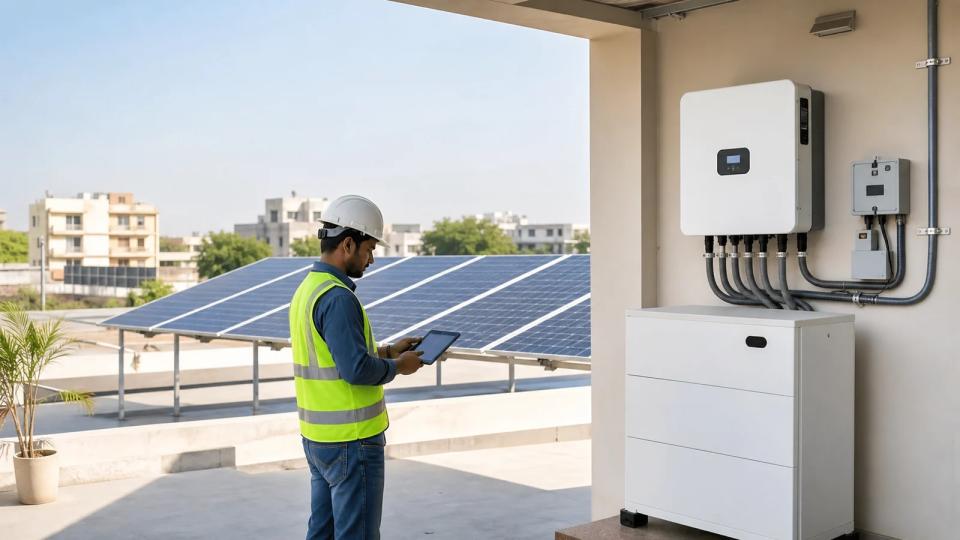
Direct answer: Solar battery backup in Rajasthan should be sized from the loads you actually need during an outage, not from battery price alone. Add the watts of essential lights, fans, Wi-Fi, office devices or critical equipment, choose required backup hours, then account for usable battery depth, inverter efficiency, safety design and maintenance access.
Last reviewed: 29 June 2026. This guide is for Rajasthan homes, offices, clinics, shops and small commercial sites. Backup hours, cost, battery life and savings are indicative until NVH Solar checks the site, existing inverter, sanctioned load, wiring, ventilation, bill pattern and current DISCOM/RERC requirements.
Key takeaways
- Battery backup is a continuity solution first; bill savings are secondary and site-specific.
- A normal on-grid solar system usually shuts down during a grid outage unless a hybrid or backup design is installed.
- Size the battery from critical loads and backup hours, then check usable kWh after depth-of-discharge and inverter losses.
- Rajasthan sites need extra attention to heat, dust, ventilation, monsoon moisture, earthing and safe electrical isolation.
- Ask for a separate battery/inverter/protection quote instead of comparing only solar battery price.
When does solar battery backup make sense?
Battery backup makes sense when outages interrupt essential work, safety, comfort or business operations. A Jaipur home may need fans, lights, Wi-Fi and a refrigerator for a few hours. A clinic may need router, lights and selected medical support equipment. A small office may need internet, laptops, CCTV and billing systems. NVH Solar should map these loads before recommending solar batteries and storage.
Storage is not automatically the best answer for every rooftop solar buyer. If grid supply is reliable and your main goal is bill reduction, a simpler on-grid solar system may be more economical. If power cuts are frequent or critical loads cannot stop, a hybrid or off-grid design becomes worth evaluating.
Why normal on-grid solar may not give backup
A common misunderstanding is that rooftop solar panels will run the house whenever the sun is available. Standard on-grid inverters are designed to disconnect during a grid outage for safety. To use solar power during cuts, the site needs the right hybrid solar system, battery bank, protected-load circuit, isolation/changeover logic, earthing and protection equipment.
This is why adding a battery after installation is not always plug-and-play. The existing inverter, warranty, AC/DC protection, wiring route and available battery location must be checked. For weaker grid locations, farms, remote buildings or telecom/security loads, off-grid solar systems may also need comparison.
Backup-time calculation table
Use this simple method for early planning. Final numbers must use the actual battery model, inverter efficiency and load survey.
| Step | Example | What it means |
|---|---|---|
| Critical connected load | 600 W | Only backup loads: selected lights, fans, Wi-Fi, laptop/router, CCTV or essential equipment. |
| Nominal battery capacity | 5 kWh | The rated storage capacity, not always fully usable. |
| Usable depth of discharge | 80% | Example usable DC energy: 5 kWh x 80% = 4 kWh. |
| Inverter efficiency assumption | 90% | Example usable AC energy: 4 kWh x 90% = 3.6 kWh. |
| Indicative backup time | 3.6 kWh / 0.6 kW = about 6 hours | Actual backup will vary with load changes, battery condition, temperature and inverter settings. |
Which loads should stay on backup?
Do not put the full building on backup unless the system is explicitly sized for it. A practical Rajasthan backup panel usually includes essential lights, fans, internet router, laptop or billing machine, CCTV, selected medical or business-critical equipment and a few low-power plug points. Heavy loads need a separate engineering decision.
Avoid promising backup for geysers, large air-conditioners, water pumps, welding sets, compressors or heavy kitchen equipment unless the battery, inverter, cable, protection and budget are sized for those loads. These loads can drain storage quickly and may require higher surge capacity.
Rajasthan site checks before buying a battery
- Heat and ventilation: Battery and inverter locations should avoid trapped heat, direct rain and blocked airflow.
- Dust: Utility areas in Rajasthan can collect dust; equipment needs accessible cleaning and inspection.
- Monsoon moisture: Keep electrical equipment away from seepage, roof runoff and splash zones.
- Earthing and protection: Central Electricity Authority (CEA) safety context and MNRE rooftop quality guidance both make electrical safety, earthing and protection checks non-negotiable.
- Regulatory route: RERC's live regulation list now includes Battery Energy Storage Systems Regulations, 2026 dated 13 May 2026, so storage assumptions should be checked against current rules where grid interaction or commercial treatment matters.
- Service access: The installer must be able to inspect terminals, firmware, alerts, ventilation, breakers and battery health without unsafe access.
Battery, inverter and quote checklist
Ask the installer to show the storage design separately from the solar panel quote. The quote should identify battery chemistry, nominal kWh, usable kWh assumption, inverter model, protected-load panel, changeover/isolation method, AC/DC protection, communication compatibility, warranty terms, installation location and O&M plan. If you are upgrading an existing plant, ask for a solar inverter service check before approving storage.
Use the solar calculator only for first-pass solar sizing and payback context. Battery backup economics need a separate calculation because storage adds cost and losses but may prevent outage-related inconvenience or business interruption.
CTA: Book a free solar site survey with NVH Solar or WhatsApp/call +91 9509344453. Share your electricity bill and a list of loads you want during power cuts so the team can compare on-grid, hybrid and battery-backup options.
Maintenance after installation
Battery backup systems should be inspected periodically. The checks include inverter logs, battery state-of-health, terminal tightness, breaker condition, ventilation, error codes, firmware updates, earthing continuity and protected-load performance. NVH Solar's solar AMC and O&M can combine rooftop solar checks with inverter and battery inspections where suitable.
Sources reviewed
- RERC regulations page checked on 29 June 2026, including Battery Energy Storage Systems Regulations, 2026 dated 13 May 2026.
- MNRE Quality Control Manual for Grid Connected Rooftop Solar PV System page checked on 29 June 2026.
- Central Electricity Authority (CEA) Measures Relating to Safety and Electric Supply archive checked on 29 June 2026, with 2023 regulations used for electrical-safety context.
- NVH Solar live battery, hybrid, off-grid, inverter, AMC, calculator and contact pages checked on 29 June 2026.
FAQs
How do I calculate solar battery backup time?
Estimate backup time by multiplying nominal battery capacity by usable depth of discharge and inverter efficiency, then dividing by the connected critical load. For example, a 5 kWh battery with 80% usable depth and 90% inverter efficiency gives about 3.6 kWh usable AC energy. At 600 W critical load, that is roughly 6 hours.
Can a normal on-grid solar system run during a power cut?
Usually no. A standard on-grid system shuts down during a grid outage for safety unless it is designed with approved hybrid or backup architecture. If outage backup is required, the inverter, battery, isolation, earthing, changeover logic and protected-load wiring must be planned before installation.
Which loads should run on solar battery backup?
Put only critical loads on backup: essential lights, fans, Wi-Fi, laptop or office router, CCTV, medical or business-critical devices where appropriate. Avoid heavy loads such as geysers, large air-conditioners, pumps or welding machines unless the battery and inverter are explicitly sized for them.
Is lithium battery backup better than lead-acid backup?
Lithium systems can offer higher usable capacity, compact size and lower maintenance, while lead-acid systems may have a lower upfront cost. The safer choice depends on budget, temperature, warranty, ventilation, charge-discharge profile, service support and the inverter's battery compatibility.
Can I add a battery to an existing rooftop solar system?
Sometimes, but not automatically. The installer must check the existing inverter type, DC/AC wiring, protection devices, sanctioned load, backup-load separation, battery location and warranty impact. Some systems require a hybrid inverter or AC-coupled storage design instead of a simple battery add-on.
Does solar battery backup reduce my electricity bill?
Battery backup mainly improves continuity of supply. Bill savings depend on self-consumption, charging source, tariff, export treatment, battery losses and system cost. Do not buy storage only on a bill-saving promise; compare backup value, outage cost and site-specific economics.
Conclusion
The right solar battery backup system for Rajasthan is not the biggest battery or the cheapest battery. It is the system that safely supports the selected loads for the required hours, fits the inverter architecture, survives local heat and dust, and remains maintainable after installation.
Book the next step: Send NVH Solar your electricity bill, outage problem and critical-load list, then book a free solar site survey to compare on-grid, hybrid and battery-backup options.