How Much Electricity Does Solar Generate in Rajasthan?
How many units will rooftop solar generate in Rajasthan? This guide gives practical 1 kW, 3 kW and 5 kW estimates, explains the assumptions, and shows why roof shade, heat, dust, inverter design and bill pattern matter before choosing system size.
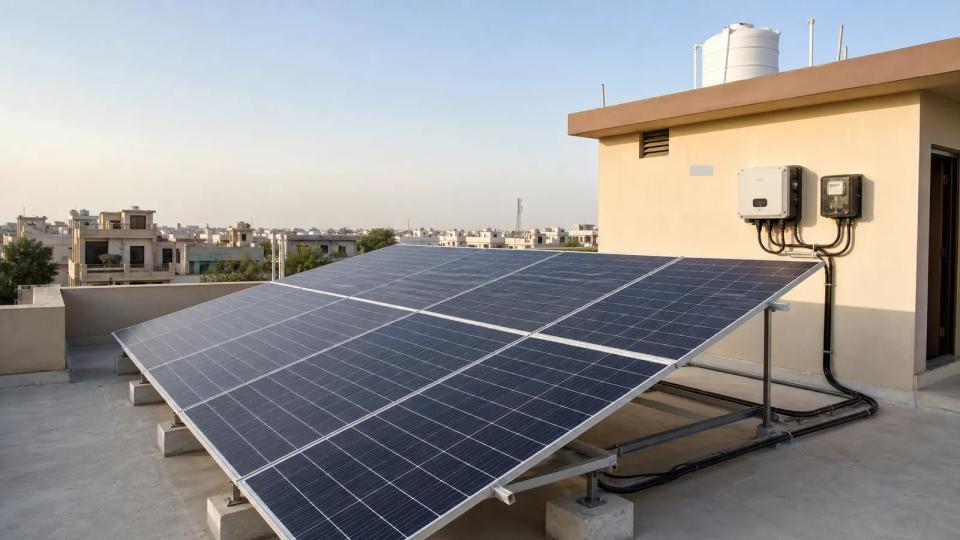
Direct answer: A well-designed, shade-free rooftop solar system in Rajasthan can be estimated at about 3.8-4.6 units per kW per day after normal system losses. That means roughly 340-415 units per month for 3 kW and 570-690 units per month for 5 kW, before site-specific checks.
Last reviewed: 14 June 2026. Author: NVH Solar Editorial Team. Technical reviewer: NVH Solar Technical Review.
Key takeaways
- Use generation estimates for planning, not as a guaranteed output promise.
- This guide uses a conservative Rajasthan planning range of 3.8-4.6 units per kW per day.
- NASA POWER solar-resource data for Jaipur, Jodhpur, Udaipur and Kota supports Rajasthan's strong sunlight context, but radiation is not the same as delivered AC electricity.
- Shade, roof direction, dust, high module temperature, inverter sizing and maintenance can change actual units.
- NVH Solar should confirm system size after reviewing your electricity bill, roof area and local DISCOM process.
Why should Rajasthan homeowners calculate units before asking for price?
Solar price only makes sense when it is connected to expected units. A lower quote can still be wrong if the system is undersized, shaded, poorly mounted or not matched to the household's daytime consumption. For a Jaipur, Kota, Jodhpur or Udaipur home, the first useful question is not only “What is the 3 kW price?” but also “How many usable units can my roof produce?”
This article is a planning guide for homeowners comparing rooftop solar for homes, on-grid solar systems and the solar calculator. It is not a substitute for a site survey.
Rajasthan solar-resource context
Solar-resource data helps set expectations before a site survey. NASA POWER climatology accessed on 14 June 2026 gives annual average daily all-sky solar radiation around 5.43-5.66 kWh/m2/day for the Rajasthan cities checked below. This is a sunlight input, not the final AC electricity generated by panels.
| City checked | NASA annual average daily solar radiation | Monthly range in the API sample | Planning note |
|---|---|---|---|
| Jaipur | 5.44 kWh/m2/day | 3.83-7.20 kWh/m2/day | Good rooftop potential, but water tanks and adjacent buildings need shade checks. |
| Jodhpur | 5.66 kWh/m2/day | 4.00-7.34 kWh/m2/day | Strong sunlight; dust and summer heat should be included in maintenance planning. |
| Udaipur | 5.45 kWh/m2/day | 4.16-7.47 kWh/m2/day | Roof direction and monsoon-season variation should be checked carefully. |
| Kota | 5.43 kWh/m2/day | 3.93-7.20 kWh/m2/day | Use bill history and JVVNL connection details before final sizing. |
Indicative solar generation by system size
The table below uses a practical planning range of 3.8-4.6 units per installed kW per day. It assumes a reasonably clear roof, correct panel orientation, suitable inverter sizing and normal system losses. It excludes unusual shading, heavy soiling, equipment faults and customer-specific net-metering settlement.
| System size | Indicative daily units | Indicative monthly units | Indicative annual units | Useful for |
|---|---|---|---|---|
| 1 kW | 3.8-4.6 units | 115-140 units | 1,390-1,680 units | Very small daytime loads or first estimate |
| 2 kW | 7.6-9.2 units | 230-275 units | 2,775-3,360 units | Small homes with modest monthly consumption |
| 3 kW | 11.4-13.8 units | 340-415 units | 4,160-5,040 units | Common residential planning size |
| 5 kW | 19.0-23.0 units | 570-690 units | 6,940-8,400 units | Larger homes, villas or higher daytime load |
| 10 kW | 38.0-46.0 units | 1,140-1,380 units | 13,870-16,790 units | Large homes or small commercial premises after load check |
How is the estimate calculated?
Use a transparent formula: expected daily units = installed kW × practical daily yield per kW. In this draft, the practical yield range is 3.8-4.6 units per kW per day for a normal Rajasthan rooftop. For 3 kW, that becomes 3 × 3.8 to 3 × 4.6, or 11.4-13.8 units per day.
Monthly units are estimated by multiplying daily units by 30. Annual units are estimated by multiplying daily units by 365. These are indicative values. A final proposal should use roof orientation, actual shade, panel make, inverter design, local dust exposure and the latest electricity bill.
What can reduce actual generation?
- Shade: water tanks, lift rooms, parapet walls, trees and adjacent buildings can reduce output disproportionately.
- Heat: Rajasthan summer sunlight is strong, but hot solar cells usually produce less power than the same panel at cooler test conditions.
- Dust: dusty roofs in Jaipur, Jodhpur, Bikaner, Kota and highway-side locations may need more disciplined cleaning and solar AMC.
- Orientation and tilt: poor orientation can reduce the useful daily generation even when the system size looks adequate.
- Inverter and cable design: undersized or poorly installed equipment can create avoidable losses and reliability issues.
- Consumption timing: net-metered export is not the same as using power instantly during daytime. Your bill impact depends on the DISCOM settlement and fixed charges.
Can a 3 kW or 5 kW system make the bill zero?
Do not size the system from a zero-bill promise. A rooftop system can reduce the energy component of the bill, but the final payable amount depends on imported units, exported units, fixed charges, taxes, sanctioned load, monthly consumption pattern and the applicable JVVNL, AVVNL or JDVVNL process.
For homes planning subsidy-linked installation, also review NVH Solar's PM Surya Ghar subsidy guide for Rajasthan. For price comparison, use the solar panel price Rajasthan page alongside this generation guide.
Rajasthan homeowner checklist before finalising system size
- Collect the latest electricity bill and, if available, 12 months of unit history.
- Check sanctioned load, consumer category and the responsible DISCOM from the bill.
- Mark shadow-free roof area between 9 a.m. and 4 p.m. on a normal day.
- List high-consumption loads such as ACs, pumps, geysers and EV charging plans.
- Compare 2 kW, 3 kW and 5 kW options with both generation and budget, not price alone.
- Ask whether the proposal includes modules, inverter, structure, earthing, AC/DC protection, monitoring and documentation.
- Book a roof survey before paying a large advance.
CTA: Book a free rooftop solar site survey with NVH Solar or call +91 9509344453 for a Rajasthan-specific system-size recommendation.
Source references
- NASA POWER Climatology API documentation, accessed 14 June 2026: explains the climatology API used for city solar-resource checks.
- NASA POWER Jaipur point data, accessed 14 June 2026: all-sky daily solar radiation value used for Jaipur context.
- MNRE Grid Connected Rooftop Solar Programme, last updated 14 February 2025, accessed 14 June 2026: official rooftop solar programme and DISCOM verification context.
- RERC regulations page, accessed 14 June 2026: Rajasthan regulatory source for distributed renewable-energy and rooftop/net-metering references.
- NVH Solar contact page, accessed 14 June 2026: verified CTA destination and phone number.
Conclusion
A practical Rajasthan planning range is 3.8-4.6 units per kW per day for a well-designed rooftop solar system, but the correct system size still depends on the bill, roof and usage pattern. Treat 3 kW and 5 kW generation tables as a starting point, not as a guarantee.
NVH Solar can review your roof, consumption history, subsidy eligibility and DISCOM path before recommending the final size. Book a free rooftop survey to convert these estimates into a site-specific proposal.
FAQs
How many units does a 3 kW solar system generate in Rajasthan?
Using this draft's conservative 3.8-4.6 units per kW per day assumption, a 3 kW rooftop solar system may generate about 11.4-13.8 units per day, 340-415 units per month and 4,160-5,040 units per year. Treat this as an estimate until the roof and bill are checked.
How many units does a 5 kW solar system generate in Rajasthan?
A 5 kW rooftop solar system may generate about 19.0-23.0 units per day, 570-690 units per month and 6,940-8,400 units per year under the same assumptions. Shade, dust, inverter sizing and module orientation can move the result outside this range.
Is Rajasthan sunlight enough for rooftop solar?
Yes, Rajasthan has strong solar-resource conditions, but sunlight alone is not the full answer. NASA POWER climatology for Jaipur, Jodhpur, Udaipur and Kota shows annual average daily solar radiation around 5.43-5.66 kWh/m2/day; final electricity depends on system design and losses.
Can rooftop solar make my electricity bill zero?
It can reduce the grid bill sharply for some homes, but a zero bill should not be promised. The result depends on monthly consumption, daytime self-use, sanctioned load, net-metering settlement, fixed charges, taxes and seasonal generation.
Why does summer heat reduce solar output even when sunlight is high?
PV modules usually produce less power as cell temperature rises above standard test conditions. Rajasthan summer has strong sunlight, but high module temperature, dust and inverter limits can reduce the realised output compared with a simple sunlight-only estimate.
Should I size solar only from monthly units?
No. Monthly units are the starting point, but the final size should also consider roof area, shade, sanctioned load, day/night usage pattern, future appliances, subsidy eligibility and DISCOM process. NVH Solar should confirm size after a site survey and bill review.