How Much Solar Do You Need for a 1.5 Ton AC in Rajasthan?
There is no fixed panel count for a 1.5 ton AC. This Rajasthan guide shows how to use the AC's BEE label, daily running hours, practical rooftop yield, complete home load and backup requirement to estimate the right solar-system size.
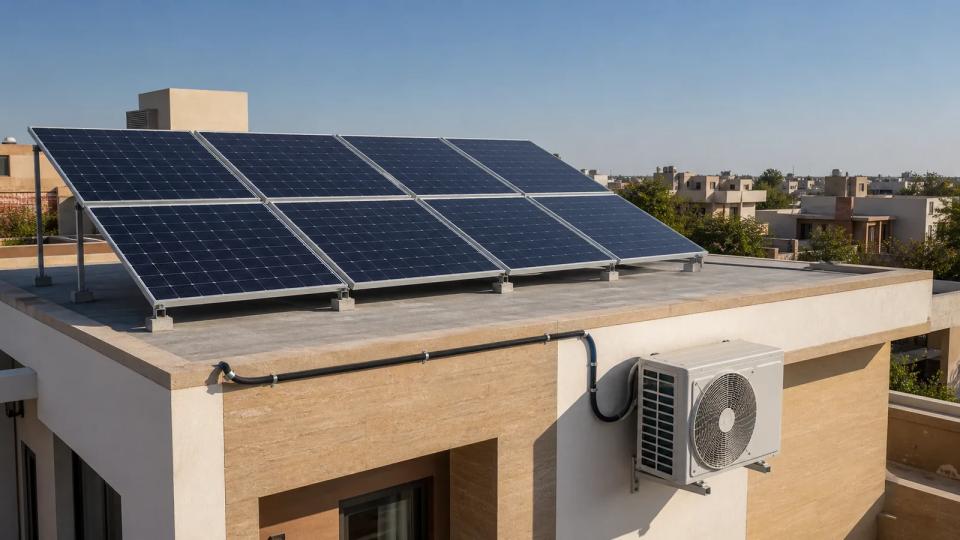
Direct answer: There is no fixed panel count for a 1.5 ton AC. As an illustration, an inverter AC averaging 1.2 kW for six hours uses 7.2 units a day. At a Rajasthan planning yield of 3.8–4.6 units per installed kW per day, that energy alone needs about 1.6–1.9 kW of solar before site margin. Final sizing must include the complete house load, BEE label data, roof conditions and backup needs.
Last reviewed: 14 July 2026. This guide is for Rajasthan homeowners comparing rooftop solar for air-conditioning loads. Every calculation below is indicative; use the actual AC label, electricity bills and a site survey before buying.
Key takeaways
- “1.5 ton” describes cooling capacity, not a fixed electrical demand. Read the model-specific BEE label and nameplate.
- Calculate daily AC energy as average input power in kW multiplied by actual running hours.
- On-grid solar can offset daytime AC energy, but a normal grid-tied system does not run the AC during a power cut.
- Night-time AC use comes from the grid unless a correctly engineered hybrid inverter and battery are included.
- Size the rooftop system for the whole property, not only the AC, and validate roof area, shade, sanctioned load and the local DISCOM process.
Why does a 1.5 ton AC not have one fixed solar size?
Two 1.5 ton air conditioners can consume different amounts of electricity. Compressor technology, BEE star rating, room heat gain, insulation, thermostat setting, outdoor temperature, maintenance and operating hours all change the result. An inverter AC also varies its input as the room approaches the set temperature.
The Bureau of Energy Efficiency requires room-AC labels to show model information including cooling capacity, power consumption, star level and whether the compressor is variable speed. Those model-specific values are more useful than a generic internet claim such as “four panels run one AC.” Start with the label and, where possible, compare it with actual bill or smart-meter data.
How do you calculate the AC's daily solar requirement?
Use a transparent two-stage calculation:
- Daily AC energy (kWh) = average AC input (kW) × daily running hours.
- Energy-only solar allocation (kW) = daily AC energy ÷ practical daily solar yield per installed kW.
NVH Solar's current Rajasthan solar-generation guide uses an indicative planning range of 3.8–4.6 units per installed kW per day for a reasonably clear, correctly designed rooftop. This is not a guaranteed output. Shade, dust, module temperature, inverter design, orientation, downtime and seasonal weather can move the result outside that range.
Illustrative 1.5 ton AC sizing scenarios
| Illustrative average AC input | Use per day | AC energy per day | Energy-only PV at 3.8–4.6 units/kW/day |
|---|---|---|---|
| 0.9 kW | 4 hours | 3.6 kWh | About 0.8–0.9 kW |
| 1.2 kW | 6 hours | 7.2 kWh | About 1.6–1.9 kW |
| 1.5 kW | 8 hours | 12.0 kWh | About 2.6–3.2 kW |
These are examples, not product specifications or final system sizes. They exclude fans, refrigerators, pumps, lighting, cooking loads, a second AC, conversion losses, future demand and site margin. A proposal may round upward after the complete load and roof are checked. Panel count also changes with module wattage: system kW, not a memorised number of panels, is the useful starting point.
What data should a Rajasthan homeowner collect first?
- Download or photograph the last 12 months of electricity bills.
- Record the AC model, BEE star label, rated power input and annual energy information shown for that model.
- Note realistic summer and monsoon running hours, including whether the AC runs mostly in daylight or at night.
- List all loads that may run at the same time: other ACs, geyser, pump, induction cooktop, refrigerator, fans and office equipment.
- Check the sanctioned load, consumer category and responsible DISCOM on the bill.
- Mark roof area that stays shadow-free during useful solar hours and identify water tanks, parapets and neighbouring buildings.
Enter the property's average monthly units in NVH Solar's solar calculator for an initial whole-home estimate. The calculator is a planning aid; the final recommendation should reconcile the bill history with future AC use and the roof survey.
Will on-grid solar run the AC during a power cut?
Normally, no. A standard on-grid solar system shuts down when the utility grid fails so it does not energise a line that technicians may be repairing. The Central Electricity Authority's safety guidance treats isolation and anti-islanding behaviour as essential grid-safety functions.
If running an AC during outages is mandatory, ask for a separate hybrid solar assessment. The engineer must check the AC's starting and running demand, inverter surge capability, essential-load circuit, battery discharge limit, expected backup duration and coordination with any generator. Adding panels alone does not create backup.
How much battery is needed for night-time AC use?
Battery sizing is an energy and power calculation, not a tonnage shortcut. For example, the illustrative 1.2 kW average input used for six hours equals 7.2 kWh of AC energy before inverter and battery losses. A battery must also remain within its permitted depth of discharge and supply the AC's instantaneous demand. That makes the nominal battery capacity larger than the simple 7.2 kWh figure.
Use NVH Solar's solar battery planning service only after deciding which loads truly need backup. Supporting one bedroom AC for two hours is a different design from supporting three ACs all night. A grid-first approach is often more economical when the main goal is bill reduction rather than outage backup.
What Rajasthan roof conditions change the answer?
Rajasthan homes need a site-specific check for summer heat, dust, wind exposure, water-tank shade, parapet shade, cleaning access and monsoon drainage. High ambient temperature can raise cooling demand while hot modules may produce less than their nameplate rating. Dust and hard-water deposits can reduce output if maintenance is neglected.
Jaipur, Jodhpur, Kota, Ajmer, Bikaner and Udaipur also fall under different local grid and DISCOM contexts. Do not copy a neighbour's size without checking your bill, sanctioned load and roof. The correct residential rooftop solar proposal should show the assumptions behind estimated generation and explain what happens in each season.
Does PM Surya Ghar subsidy depend on the AC load?
No. PM Surya Ghar central financial assistance is linked to an eligible residential grid-connected rooftop installation and the applicable scheme process; it is not a subsidy for an air conditioner. MNRE's operational guidance requires the residential consumer to follow the portal, vendor and DISCOM verification process. Check the current official portal before relying on any amount or eligibility claim.
An AC-heavy home may need a larger system than the capacity supported by a particular subsidy calculation. The customer should compare gross system cost, eligible assistance, roof feasibility, sanctioned load and expected annual generation separately. Never increase the AC-load estimate just to chase a subsidy number.
Seven checks before accepting a solar-for-AC quote
- The proposal uses the actual AC label or measured input, not tonnage alone.
- Running hours and daytime-versus-night-time use are written down.
- All concurrent household loads and future appliances are included.
- The generation estimate states a daily-yield assumption and site losses.
- On-grid and backup behaviour are explained separately.
- Roof shade, structure, access, drainage, earthing and protection are surveyed.
- Subsidy, sanctioned load, net metering and DISCOM steps are verified rather than promised.
For a bill-and-roof-based recommendation, book a free rooftop solar site survey with NVH Solar. Bring the latest bill and a photo of the AC's BEE label so the discussion starts with real data.
Sources and references
- Bureau of Energy Efficiency: Star Labelled Appliances — updated 14 April 2026; explains that star labels communicate appliance energy performance for consumer comparison.
- Bureau of Energy Efficiency: Room Air Conditioner labelling regulations — label particulars include cooling capacity, power consumption, star level and variable-speed status.
- Central Electricity Authority: Measures Relating to Safety and Electric Supply — current archive for the 2023 regulations and 2026 amendment.
- Ministry of New and Renewable Energy: Quality Control Manual for Grid Connected Rooftop Solar PV System — rooftop design, protection, commissioning and quality-control context.
- MNRE: PM Surya Ghar operational guidelines for residential CFA — dated 7 June 2024; scheme process and residential scope.
FAQs
How many solar panels are needed for a 1.5 ton AC?
There is no universal panel count. Check the AC's BEE label or measured average input, multiply by daily running hours, and size the whole rooftop system from total property energy. Module wattage, roof losses and site margin determine the final panel count.
Can a 3 kW solar system run a 1.5 ton AC?
A 3 kW system may offset the energy of one efficient 1.5 ton AC plus some household loads in a suitable daytime-use scenario, but it is not a guarantee. Actual AC input, hours, other loads, roof conditions and seasonal generation must be checked.
Can I run the AC directly from solar panels without a battery?
In an on-grid system, solar generation can offset daytime AC consumption while the grid stabilises supply. It is not a direct panel-to-AC connection. During a grid outage, a standard on-grid inverter shuts down; backup requires a compatible hybrid design.
How much solar is needed for two 1.5 ton ACs?
Calculate each AC separately and include the hours when both run together. Two units do not always consume exactly twice as much because inverter compressors modulate, but the design must cover concurrent power, total daily energy and other household loads.
Will rooftop solar run an AC at night?
Solar panels do not generate at night. The AC will use grid electricity unless a hybrid inverter and sufficiently sized battery are installed. Battery capacity must account for energy, inverter losses, depth of discharge and the AC's power demand.
Is PM Surya Ghar subsidy available for a solar system used with ACs?
Eligible residential grid-connected rooftop systems may follow the current PM Surya Ghar process, but the assistance is for the rooftop installation, not for an AC. Verify current eligibility, capacity treatment, vendor and DISCOM requirements on the official portal.
Conclusion
A 1.5 ton AC should be translated into measured or label-based energy before solar is sized. Use 12 months of bills, real running hours, concurrent loads and roof conditions, then choose on-grid or hybrid behaviour deliberately. Speak with an NVH Solar engineer for a Rajasthan-specific survey and system-size recommendation.