Solar Inverter Tripping in Rajasthan: Monsoon Fault Checklist
If your rooftop solar inverter trips during Rajasthan's monsoon or duststorm season, do not keep resetting it. This guide explains safe user checks, technician-only tests, earthing, SPD, ACDB/DCDB and AMC steps before restarting the system.
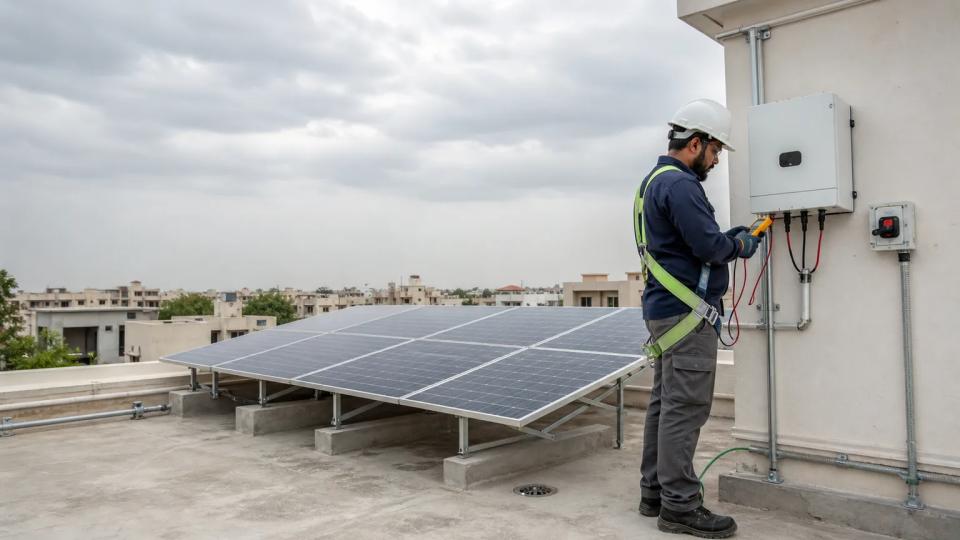
Direct answer: If your solar inverter trips after rain, duststorm or lightning in Rajasthan, do not keep resetting it. Note the error code, stay away from wet electrical equipment, and ask a trained technician to check grid voltage, insulation, earthing, SPDs, ACDB/DCDB, cable water ingress and inverter logs before restart.
Last reviewed: 20 June 2026. This is a safety and maintenance guide, not a substitute for an on-site electrical inspection. Rooftop solar systems can carry dangerous DC voltage in daylight even when the inverter is off.
Key takeaways
- An inverter trip is often a protection response, not proof that the inverter has failed.
- Rain, duststorm and lightning can expose insulation leakage, loose connectors, SPD damage, earthing issues and grid-voltage instability.
- User checks should stop at reading the display, noting the fault code and confirming whether the trip repeats.
- Opening the inverter, ACDB, DCDB, combiner box or module connectors is technician-only work.
- A monsoon AMC should include electrical safety checks, not just panel cleaning.
Why this matters in Rajasthan during monsoon
Rajasthan rooftop solar systems face a difficult mix of summer heat, dust, sudden wind, water pooling and lightning exposure. IMD's 19 June 2026 press release recorded heavy rainfall at isolated places over West Rajasthan in the previous 24 hours and forecast duststorm activity over West Rajasthan during 19-20 June. It also forecast thundersquall activity over East and West Rajasthan on 20 June and thunderstorm, lightning and gusty winds during 21-23 June.
That weather pattern is exactly when weak cable glands, loose MC4 connectors, damp junction boxes, poor earthing or surge-protection damage can show up as inverter trips. If the system is grid-connected, the inverter may also shut down when it detects grid anomalies. MNRE's rooftop quality manual notes that grid-connected rooftop PV systems use inverters and are designed to shut down when grid parameters are abnormal.
What should you do first when the inverter trips?
Use this order. It keeps the homeowner safe and gives the technician useful evidence.
- Do not touch wet equipment, exposed wires, ACDB/DCDB switches or connectors.
- Read the inverter display or mobile-app message from a safe distance.
- Note the exact error code, time, weather condition and whether the power grid was unstable.
- Check whether the fault clears only once after normal weather returns. If it repeats, stop resetting.
- Book a trained inspection through Solar AMC and O&M in Rajasthan or solar inverter service.
Inverter trip symptoms and likely check points
| Symptom | Possible area | Safe user action | Technician check |
|---|---|---|---|
| Trip after rain or damp morning | Insulation leakage, water ingress, connector moisture | Do not open equipment; note code and weather | Insulation resistance, MC4, glands, conduits, junction boxes |
| Trip during storm or lightning | SPD operation, earthing, surge damage, grid disturbance | Stay off the roof until weather is clear | SPD status, earthing continuity, inverter logs, AC protection |
| Trip at same time every sunny day | Grid voltage, inverter temperature, overload or ventilation | Record time and load pattern | Grid-voltage log, inverter temperature, airflow and sizing |
| Breaker trips but inverter display is blank | ACDB, MCB/RCCB, wiring, grid supply | Do not repeatedly push breakers on | AC circuit, terminal torque, RCCB/RCBO suitability and fault current |
| Generation stops after cleaning | Water near connectors, loose cable, wet junction box | Stop cleaning and keep distance | Connector seating, cable routing and moisture path |
Which checks are technician-only?
Anything inside the inverter, ACDB, DCDB, combiner box, string connector or earthing pit should be treated as technician-only. Waaree's module manual states that only authorised and trained personnel should work on modules or solar systems, and it cautions against handling modules when wet. It also recommends using a suitably rated DC isolator before disconnecting connectors, because DC power may remain active for some time.
During an AMC visit, the technician should check AC and DC isolators, cable glands, MC4 connectors, junction boxes, inverter ventilation, SPD indicators, module-frame bonding, earthing continuity and water-collection points. MNRE's manual lists earthing, lightning protection and surge protection as separate rooftop PV system requirements, and mentions IP-rated enclosures for outdoor equipment.
How is this different from solar panel cleaning?
Cleaning removes dust from the module glass. Inverter tripping is an electrical diagnosis. A cleaning visit may miss a loose AC terminal, failed SPD, damp DC connector, poor earth continuity or grid-voltage issue. If your main symptom is loss of generation after rain or a repeated inverter error, read the related solar panel cleaning checklist, but book an electrical inspection rather than only a wash.
On-grid and hybrid systems need different questions
Most on-grid solar systems stop exporting when grid conditions are outside inverter limits. That protection is normal. A hybrid solar system may keep selected backup loads running, but it still needs correct isolation, earthing, surge protection and battery/inverter safety. Do not assume a battery system makes storm faults safe to ignore.
When should you call NVH Solar?
Call when the inverter trips repeatedly, shows an insulation or ground-fault message, trips after rain, trips after a lightning event, has visible water near cable entry points, or stops generation after cleaning. NVH Solar can inspect residential, commercial and hybrid rooftop systems across Rajasthan and help decide whether the issue is grid-side, inverter-side, roof-cabling, earthing or maintenance-related.
CTA: For a repeat inverter fault in Rajasthan, book a free rooftop solar inspection with NVH Solar or call +91 9509344453. Share the error code, photo of the display and recent weather condition before the visit.
FAQs
Why does a solar inverter trip after rain?
Rain can expose weak insulation, loose connectors, water ingress in ACDB/DCDB boxes, damp conduits, poor earthing, grid-voltage swings or damaged surge protection. The inverter may shut down to protect the system. Do not repeatedly reset it until a trained technician checks the fault path.
Can I reset my solar inverter myself?
You can note the error code, time and weather condition, and check the display from a safe distance. Do not open the inverter, ACDB, DCDB or combiner box. If the trip repeats, stop resetting and call a qualified solar technician.
Is solar panel earthing important in Rajasthan?
Yes. Earthing and bonding are important because Rajasthan rooftops face heat, dust, wind, lightning and water accumulation during monsoon. The MNRE rooftop quality manual lists earthing, lightning protection and surge protection as system elements that must be checked.
What should be checked during a solar AMC visit?
A useful AMC visit checks inverter logs, grid voltage, ACDB/DCDB, isolators, SPDs, earthing continuity, cable routing, MC4 connectors, water-logged areas, module-frame bonding, drainage and visible corrosion. Cleaning alone is not a complete monsoon safety check.
Should I switch off solar during a thunderstorm?
Do not climb to the rooftop during a storm. If the system has accessible labelled isolators and you have been trained by the installer, follow the installer procedure. Otherwise stay away from equipment and ask the technician to inspect the system after severe lightning, duststorm or water ingress.
Does inverter tripping mean the inverter is faulty?
Not always. The inverter may be reacting correctly to grid anomalies, insulation leakage, moisture, SPD damage, loose terminals or poor earthing. Diagnosis should start from the displayed error code and site checks, not from immediate inverter replacement.
Sources
- IMD Press Release, 19 June 2026
- MNRE Quality Control Manual for Grid Connected Rooftop Solar PV System
- Waaree PV module installation manual reviewed locally on 20 June 2026
Conclusion
A solar inverter trip during Rajasthan's monsoon season should be treated as a warning, not an inconvenience. The safe path is simple: record the error, avoid wet equipment, stop repeated resets and get earthing, SPD, ACDB/DCDB, cable and inverter logs checked by a trained technician.
Speak with NVH Solar for rooftop solar AMC or inverter fault inspection in Rajasthan.