Solar Earthing and Lightning Protection in Rajasthan: Monsoon Safety Checklist
Rajasthan rooftop solar systems need proper earthing, lightning protection, surge protection and periodic testing, especially before and during monsoon storms. This checklist explains what homeowners and businesses should verify before approving installation or AMC work.
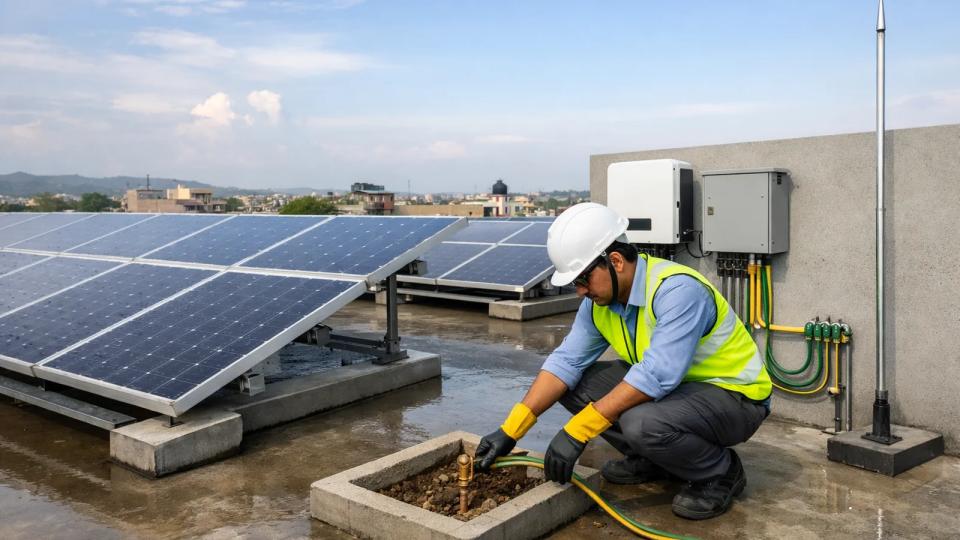
Direct answer: A safe rooftop solar system in Rajasthan should have verified equipment bonding, separate DC-side, AC-side and lightning-arrestor earthing where applicable, correctly rated surge protection, and earth-resistance test records. Before monsoon storms, do not rely on verbal assurances; ask for the earthing drawing, SPD details and measured resistance values.
Last reviewed: 24 June 2026. This article gives a consumer safety checklist for Rajasthan rooftop solar users. Final design and testing must be done by a qualified solar electrician or engineer at the site.
Key takeaways
- Solar earthing is not a cosmetic wire; it is part of electrical safety and fault protection.
- MNRE guidance says earth resistance should be as low as possible and never higher than 5 ohms; the installation-testing section says the desired electrode resistance is around 1 ohm and must be below 5 ohms.
- For grid-connected rooftop solar, MNRE guidance calls for separate DC-side, AC-side and lightning-arrestor earthing with proper insulation.
- Lightning protection and surge protection are related to earthing, but they are not the same thing.
- Rajasthan monsoon storms, dust, wet roofs and gusty winds make pre-monsoon inspection more important for homes, shops, hotels and factories.
Why earthing matters more during Rajasthan monsoon
Rooftop solar systems operate outdoors. Panels, module mounting structures, inverter cables, DCDB, ACDB and metal enclosures face heat, dust, rainwater and wind. IMD's 19 June 2026 press release forecast thunderstorm, lightning, gusty winds, thundersquall and duststorm activity over East and West Rajasthan during parts of 19-25 June 2026. That does not mean every system will fail, but it does mean safety checks should be current.
For a new rooftop solar for home in Rajasthan installation, earthing should be part of the design and commissioning record. For an existing system, the same checks belong in solar AMC and O&M in Rajasthan, especially before the rainy season.
What proper solar earthing should include
MNRE's quality manual says each PV array structure, LT power system, switchyard earthing grid, electrical equipment, inverter and junction boxes should be grounded properly as per IS 3043-2018. It also states that all metal casing or shielding should be grounded in accordance with CEA safety regulations, and that lightning arrester or mast placement should cover the SPV panel volume through the correct conductor path.
| Item to check | What the installer should show | Why it matters |
|---|---|---|
| DC-side earthing | Earth pit or approved earth path, conductor route and continuity test. | Protects the PV array and DC-side equipment from fault and surge risk. |
| AC-side earthing | ACDB/inverter earthing path, residual-current or earth-fault protection where required. | Reduces shock and fault risk on the grid-connected side. |
| Lightning-arrestor earthing | Separate lightning protection earth path and test record. | Prevents lightning energy from being routed casually through the panel frame. |
| Earth resistance | Measured values, date, instrument and tester name. | MNRE guidance requires resistance below 5 ohms and records should prove it. |
| SPDs and surge arrestors | DCDB/ACDB protection details and ratings. | Surges can damage inverter electronics and protection devices if not specified. |
| Bonding of modules and structure | Bonding hardware, lugs, clamps and conductor continuity. | All module frames and structure parts must be electrically bonded, not visually assumed. |
How lightning protection differs from earthing
Earthing connects exposed conductive parts to earth so fault current has a safer path. Lightning protection is a separate design intended to reduce lightning-related overvoltage before it reaches PV modules, inverters or other components. MNRE guidance says the lightning arrester should not be installed on the mounting structure, and the SPV array space should be suitably protected by the required lightning arrestors where needed.
In plain terms, do not accept a quote that says “earthing and LA included” without drawings. Ask whether the lightning arrester is positioned separately, whether the earth path is separate, whether DCDB and ACDB surge protection is included, and whether the system will be tested after installation.
Quote checklist before approving rooftop solar
- Ask for the earthing layout, not just a line item saying “earthing”.
- Check whether DC side, AC side and lightning-arrestor earthing are separated as per design.
- Ask for the conductor material and size. MNRE guidance notes a minimum 6 mm2 copper or equivalent PV-array earthing conductor when no lightning system is installed, and 16 mm2 copper or equivalent when a lightning protection system is installed.
- Confirm DCDB/ACDB protection class. MNRE guidance mentions IP 65 or better for DCDB and outdoor AC panels as per site conditions.
- Ask whether surge protection devices or surge arrestors are included in the DC and AC protection chain.
- Ask for post-installation continuity and earth-resistance testing.
- Confirm whether periodic earthing checks are included in AMC.
If you are comparing on-grid solar systems, this checklist should sit beside module, inverter, mounting and subsidy details. A lower quotation that omits safety testing can become expensive after a fault.
Warning signs that need an engineer
Do not open DB boxes or touch terminals yourself. Book a qualified inspection or solar inverter service in Rajasthan if you see repeated inverter earth-fault errors, inverter tripping after rain, a burning smell, visible cable cracks, water entry in DCDB or ACDB, loose earthing strips, corroded lugs, broken module glass, or a lightning arrester with burn marks or cracks.
For inverter-specific fault symptoms, read the related guide on solar inverter tripping in Rajasthan. For roof and structure checks, compare the solar panel mounting structure checklist.
What not to do after a storm
After lightning, heavy rain or a duststorm, avoid quick rooftop experiments. Do not reset the inverter repeatedly if the same earth-fault or insulation-fault message returns. Do not pour water near an earth pit to “improve” a reading without an engineer's instruction. Do not bypass an SPD, MCB, RCCB or fuse because the system is not generating. Do not tie loose earthing conductors with ordinary tape. These shortcuts can hide the real fault and increase risk for the next technician.
A safer sequence is to switch off only through the documented isolators if you know the system procedure, keep people away from wet equipment, photograph the visible fault from a distance, note the inverter error code, and call a trained solar service team. If the system is under warranty or AMC, ask for the fault report to mention earth resistance, continuity, SPD condition and visible water-entry checks.
Maintenance checklist after installation
| Inspection point | Recommended check | Consumer note |
|---|---|---|
| Earth electrode | Measure resistance periodically and keep records. | Ask for values in ohms, not only “OK”. |
| Earth pit area | Check moisture condition around the earth pit. | Dry or disturbed soil can affect performance. |
| Lightning arrestor | Inspect for overheating, flash marks, surface cracks, burst or puncture. | Replace damaged arrestors; do not keep them as decoration. |
| DB boxes and cables | Check IP protection, insects, rodents, cable insulation, corrosion and tightness. | Wet or damaged enclosures need urgent attention. |
| Module structure bonding | Verify continuity between module frames and mounting structure. | Visual contact is not enough; continuity should be tested. |
Practical next step
If your rooftop solar quote or existing system does not include earthing test records, ask for them before the next storm cycle. NVH Solar can inspect rooftop solar earthing, inverter faults, SPDs, lightning arrester condition and AMC needs across Rajasthan.
CTA: Book a free rooftop survey with NVH Solar and ask for a solar earthing and monsoon safety check.
FAQs
What is solar earthing in a rooftop solar system?
Solar earthing is the safety connection that bonds exposed metal parts, the module mounting structure, inverter, DC side, AC side and lightning protection path to earth. It gives fault current and surge energy a safer path, reducing shock, fire and equipment-damage risk when designed and tested correctly.
How many earthing pits should a rooftop solar system have?
MNRE's rooftop quality manual says grid-connected rooftop solar systems should provide separate earthing for the DC side, AC side and lightning arrestor. Small sites still need a site-specific design; the consumer should ask the installer for the approved drawing and test records instead of counting pits visually.
What earth resistance is acceptable for rooftop solar?
The MNRE quality manual says earth resistance should be as low as possible and never higher than 5 ohms. In the installation-testing section, it also states that desired electrode resistance is around 1 ohm and must be lower than 5 ohms. Treat these as test-record requirements, not verbal claims.
Is a lightning arrester the same as solar earthing?
No. Earthing bonds equipment and provides a fault path; a lightning arrester or lightning protection system is intended to intercept or divert lightning-related surge energy. Both need proper earth paths, but a lightning arrester should be designed separately and should not simply be fixed to the panel structure.
Do solar panels need surge protection devices?
Yes, where required by design. MNRE guidance for DCDB and ACDB panels refers to surge arrestors or SPDs. These devices should be correctly rated and placed in the DC and AC protection chain. A quote should mention SPDs, DB protection class and who is responsible for testing.
When should I book an earthing inspection?
Book an inspection before monsoon, after major rooftop civil work, after repeated inverter earth-fault or tripping errors, after visible cable damage, and after any lightning or severe storm event near the property. Do not touch wet panels, DCDB, ACDB or inverter terminals yourself.
Sources
- Ministry of New and Renewable Energy, Quality Control Manual for Grid Connected Rooftop Solar PV System Final Draft, checked 24 June 2026.
- India Meteorological Department, Press Release dated 19 June 2026, checked 24 June 2026.
- Waaree Energies module installation manual, checked 24 June 2026.